
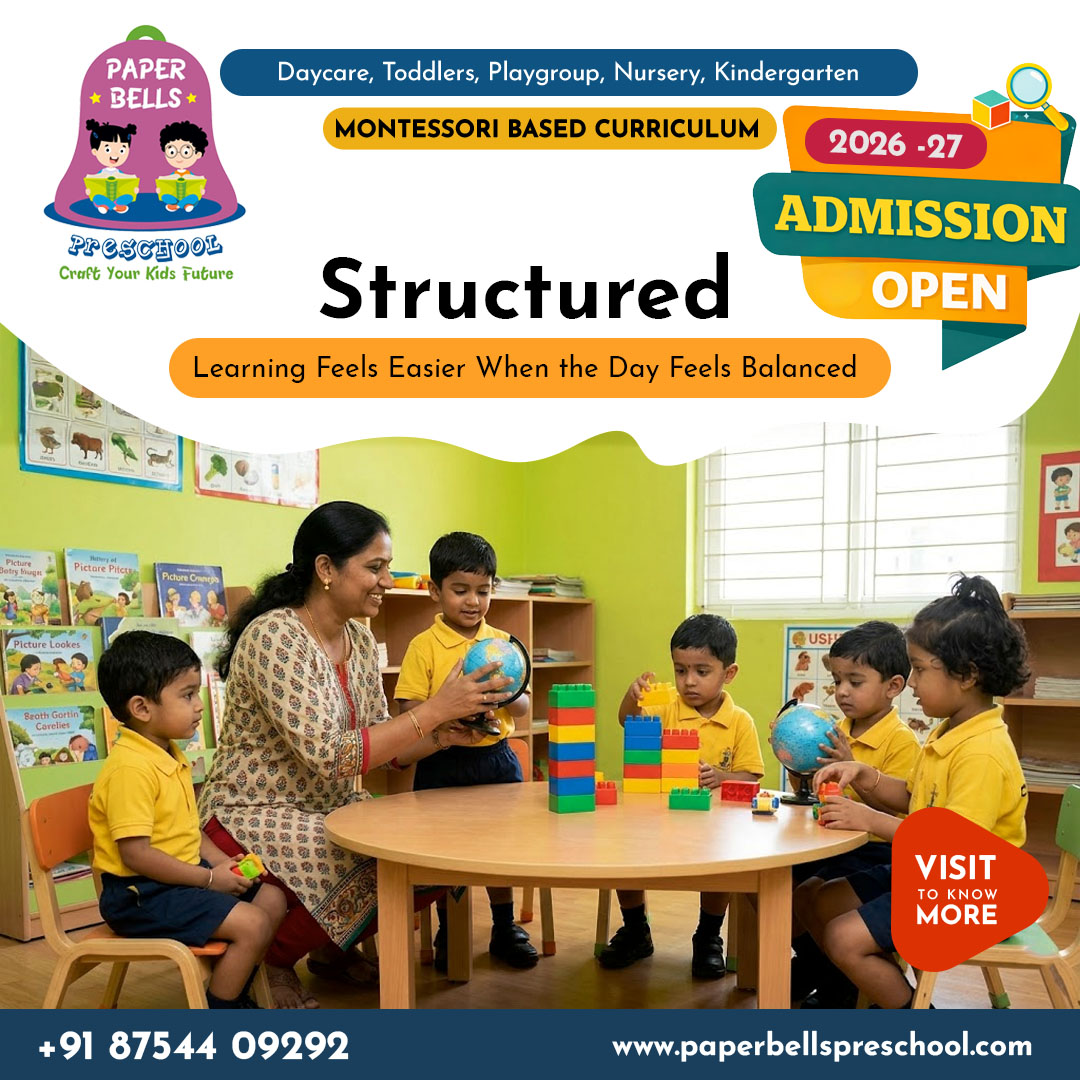
When people imagine preschool, they often picture colourful rooms, playful activities, and happy children moving from one task to another. While these moments matter, they are only the surface of what truly shapes a child's early years. What matters far more is what holds those moments together.
Early education is not a collection of activities. It is a system. At Paperbells Preschool, one of the premium preschools in Hebbal, we believe that children do not grow through isolated experiences. They grow through continuity, structure, and thoughtful design. Every interaction, transition, and routine works together to create a day that feels safe, predictable, and meaningful to a young child.
What Children Actually Experience at School
Children do not arrive at preschool thinking about learning outcomes. They arrive sensing tone, rhythm, and atmosphere. Before they understand what an activity is for, they understand how it makes them feel. A child experiences their day as a whole, not in parts. They do not separate playtime from learning time or activity from transition. To them, it is one continuous experience. At Paperbells Preschool, this understanding guides every decision we make. Instead of asking, "What activities should we add?" we ask, "How will this fit into the child's day?" Because when the system works, children move through their day with ease, confidence, and curiosity.
Why Structure Creates Freedom for Young Minds
Structure is often misunderstood as rigidity. In early education, the opposite is true. When children know what to expect, they feel secure. When they feel secure, they explore freely. Predictable routines reduce anxiety and help children focus their energy on engagement rather than adjustment. At Paperbells Preschool in Hebbal, structure is not about control. It is about clarity. The day flows in a familiar rhythm that children quickly internalise. This rhythm allows them to participate without hesitation, to transition without resistance, and to approach new experiences with confidence. Freedom grows best inside a well-designed framework.
The Hidden Power of Daily Systems
Systems are quiet. They do not announce themselves, but their impact is constant.
A well-designed system ensures that learning does not depend on mood, chance, or improvisation. It ensures consistency, even as children, teachers, and days change. At Paperbells Preschool, systems support everything - from how children are welcomed in the morning, to how materials are introduced, to how transitions are handled gently and without rush. These systems allow educators to focus fully on children, rather than logistics. When systems are strong, the classroom feels calm without effort.
Why Activities Alone Are Never Enough
Activities are important, but they are only effective when placed within the right context.
An activity without preparation can overwhelm. An activity without closure can confuse. An activity without continuity can feel disconnected. At Paperbells Preschool, activities are thoughtfully sequenced within the day. Each experience builds on the one before it, helping children make sense of what they are doing without needing explanation. Children learn best when learning feels natural, not staged.
The Role of Transitions in Early Learning
The moments between activities often shape a child's experience more than the activities themselves.
Transitions teach patience, flexibility, and emotional regulation. When transitions are rushed or unclear, children feel unsettled. When they are calm and predictable, children move smoothly from one experience to the next. At Paperbells Preschool, transitions are treated as learning moments, not interruptions. They are unhurried, supported, and consistent. This helps children maintain emotional balance throughout the day. A well-run system respects the in-between moments.
How Systems Support Emotional Safety
Young children are constantly learning how the world works. A stable system reassures them that the world is understandable and safe. At Paperbells Preschool in Hebbal, emotional safety is built into the system itself. Consistent responses from educators, familiar routines, and prepared environments allow children to relax into their day. When children feel emotionally safe, they are more willing to try, to fail, and to try again.
Educators Thrive When Systems Are Clear
A strong system does not limit educators - it supports them.
When expectations, routines, and processes are clear, teachers can respond thoughtfully instead of reactively. They have the space to observe, guide, and connect with children on an individual level. At Paperbells Preschool, educators are not left to manage chaos. They work within a structure that allows them to bring warmth, attentiveness, and consistency into every interaction. Children sense this steadiness immediately.
Consistency Is What Children Trust
Children trust what repeats.
Consistency helps children form internal patterns that guide their behaviour and expectations. When the day unfolds in a familiar way, children begin to anticipate rather than resist. At Paperbells Preschool, consistency does not mean monotony. It means dependable rhythms that anchor new experiences. This balance helps children remain open to learning without feeling overwhelmed. Trust grows through repetition.
Why Calm Days Are Intentionally Designed
Calm does not happen by accident. A calm classroom is the result of aligned systems working quietly in the background. When routines, transitions, and expectations are clear, children do not need constant correction. At Paperbells Preschool, calm is the outcome of preparation. The environment, the schedule, and the educator's role all work together to create a day that feels steady and supportive. Calm allows learning to deepen naturally.
Learning Happens When the Day Makes Sense
When children understand the flow of their day, they feel capable. They move with purpose rather than uncertainty. At Paperbells Preschool in Hebbal, learning is embedded into the system itself. Children are not rushed through content or overloaded with information. Instead, they are guided through experiences that build gradually and meaningfully. Understanding emerges when children are not distracted by confusion.
Why Early Education Must Be Thoughtfully Designed
Early education shapes how children feel about learning long before academics begin. A well-designed system teaches children that learning is approachable, predictable, and rewarding. It builds habits of attention, confidence, and independence that stay with them beyond preschool. At Paperbells Preschool, every aspect of the day is intentional. Nothing is random, and nothing is rushed. This thoughtful design is what allows children to settle in, grow steadily, and enjoy their learning journey.
A Preschool Experience That Feels Grounded and Assured
Families often recognise a strong system not through explanation, but through experience. Children who settle in smoothly. Days that feel balanced. A sense that things are handled with care and foresight. These are signs of a preschool that understands early education as a system, not a checklist. As one of the premium preschools in Hebbal, Paperbells Preschool is built on this philosophy - quietly confident, deeply considered, and focused on what truly supports young children.
Where Thoughtful Systems Create Confident Beginnings
Early education works best when it is cohesive. At Paperbells Preschool, children are not moved from activity to activity. They are guided through a well-structured day that supports their emotional, social, and cognitive growth naturally. Because when early education functions as a system, children don't just learn better - they feel better learning. And that is where strong beginnings truly begin.


