
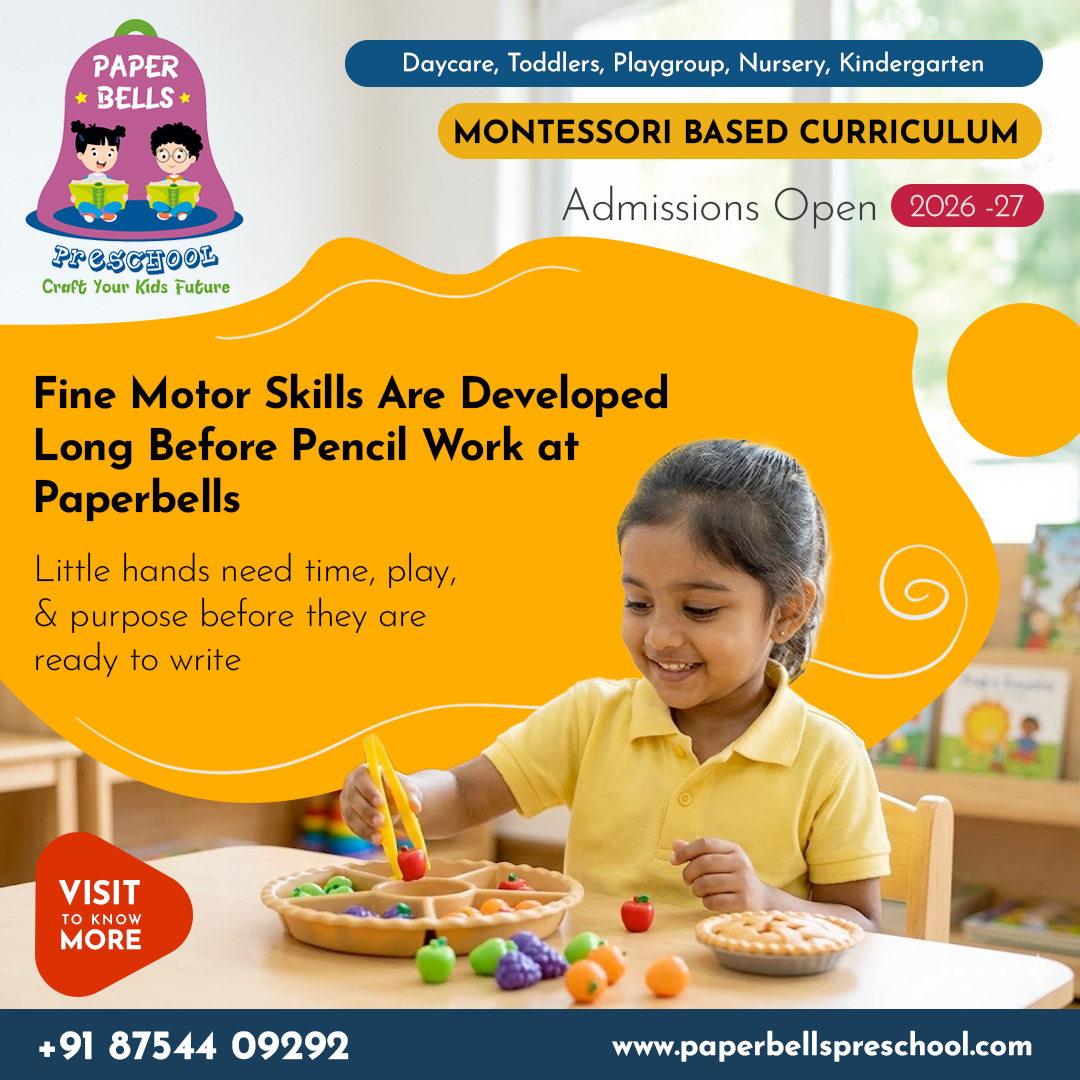
Why little hands need time, play, and purpose before they are ready to write
When parents imagine school readiness, the image is often a small child holding a pencil, carefully tracing letters on a page. Writing feels like a visible milestone - the proof that learning has begun. But what often goes unnoticed is everything that must happen before a child is ready to hold that pencil with ease.
Strong writing does not begin with worksheets.
?It begins with hands that have learned to move with confidence.
At Paperbells Preschool, one of the premium preschools in Hebbal, fine motor development is approached as a journey rather than a checklist. Long before children are introduced to formal pencil work, they are given rich, meaningful experiences that strengthen their hands, fingers, wrists, and coordination in natural, joyful ways.
Because when the body is ready, learning flows effortlessly.
Understanding Fine Motor Skills in Early Childhood
Fine motor skills refer to the small, precise movements of the hands and fingers that allow children to button a shirt, turn pages, build with blocks, and eventually write with control. These skills develop gradually and are deeply connected to a child's overall physical and neurological growth.
Young children are not born with the muscle strength or coordination needed for writing. Expecting early pencil work without preparation can lead to frustration, poor grip habits, and even resistance toward learning.
At Paperbells Preschool, fine motor development is respected as a foundational process - one that deserves time, patience, and thoughtful planning.
Why Pencil Work Comes Later - And That's a Good Thing
Writing requires far more than knowing letters. It demands finger strength, wrist stability, bilateral coordination, and hand - eye integration. When these underlying skills are still developing, writing can feel overwhelming.
This is why Paperbells Preschool introduces pre-writing skills through purposeful play rather than early pressure. Children are allowed to build strength and coordination through activities that feel natural and enjoyable.
When writing is finally introduced, children approach it with confidence rather than fatigue.
Tearing: Strengthening Fingers Through Simple Actions
Tearing paper may look like a casual activity, but it plays a powerful role in fine motor development. The action requires controlled finger movement, coordination between both hands, and gradual strength-building.
At Paperbells Preschool in Hebbal, tearing activities are thoughtfully incorporated into art, craft, and creative exploration. Children tear paper to create collages, decorate projects, or explore textures and shapes.
Through these moments, their fingers grow stronger, their grip becomes steadier, and their control improves - all without a single worksheet in sight.
Threading: Precision, Patience, and Focus
Threading beads, laces, or natural materials is one of the most effective ways to develop hand - eye coordination and finger dexterity. It requires children to slow down, concentrate, and align their movements carefully.
At Paperbells Preschool, threading activities are designed to be engaging and age-appropriate. Children may thread beads, pasta, or other tactile materials as part of structured play or independent exploration.
These activities quietly build the precision needed for writing, while also nurturing patience, focus, and a sense of accomplishment.
Pouring: Control Through Everyday Experiences
Pouring is a deceptively powerful fine motor activity. It strengthens wrist control, hand stability, and coordinated movement - all essential for writing.
Whether children are pouring water, grains, or sand, they are learning to judge weight, angle, and movement. At Paperbells Preschool, pouring is introduced in safe, supervised ways that feel purposeful rather than artificial.
These everyday actions build confidence and independence while preparing the muscles for more refined tasks later on.
Squeezing: Building Strength With Joy
Squeezing activities, such as using dough, sponges, or soft materials, are excellent for developing hand strength. They engage the entire hand, preparing fingers for controlled movements like holding a pencil.
At Paperbells Preschool, squeezing is often part of sensory play, art, and exploration. Children knead dough, press clay, and experiment with textures that invite repeated use of their hands.
Because these activities feel playful, children naturally repeat them - strengthening their muscles without even realising they are doing so.
Why Hands Learn Best Through Play
Play is the most effective teacher in early childhood. When children are engaged, relaxed, and curious, learning happens deeply and naturally.
Paperbells Preschool embraces this philosophy fully. Fine motor development is woven into daily routines and activities rather than isolated into formal exercises. Children learn through doing, exploring, and experimenting at their own pace.
This approach ensures that skill-building never feels forced - it feels joyful.
The Role of Environment in Skill Development
The classroom environment plays a crucial role in fine motor development. At Paperbells Preschool in Hebbal, learning spaces are thoughtfully designed to encourage hands-on interaction.
Materials are placed within easy reach. Activities invite manipulation, movement, and exploration. Children are free to choose tasks that interest them, allowing repeated engagement with fine motor challenges.
This autonomy fosters confidence and supports deeper learning.
Teachers Who Observe, Support, and Guide
Fine motor development is not a one-size-fits-all process. Some children develop strength quickly, while others need more time and varied experiences.
Teachers at Paperbells Preschool are trained to observe carefully and support gently. They recognise when a child is ready for greater challenges and when they need more foundational experiences.
This responsive approach ensures that every child feels supported, capable, and confident.
The Emotional Side of Fine Motor Development
When children struggle with tasks their hands are not ready for, frustration can overshadow learning. By allowing fine motor skills to develop naturally, Paperbells Preschool protects a child's emotional relationship with learning.
Children experience success early. They feel capable. They develop perseverance rather than anxiety.
This emotional security becomes just as important as physical readiness when it comes time to write.
How Strong Hands Support Academic Growth
Fine motor skills influence far more than writing. They support reading, mathematics, self-care, and classroom independence.
Children who can manipulate materials easily are more engaged in learning. They participate confidently, complete tasks independently, and approach challenges with resilience.
At Paperbells Preschool, strong hands support strong learners.
A Thoughtful Approach Parents Can Trust
Parents today value preschools that understand development rather than rushing milestones. Paperbells Preschool reflects this understanding in its approach to fine motor skills.
By focusing on meaningful preparation rather than early outcomes, the school creates an environment where children thrive - physically, cognitively, and emotionally.
This trust allows families to feel confident that their child is learning in the right way, at the right time.
Before the Pencil, the Hand Must Be Ready
Writing is not the beginning of learning - it is the result of careful preparation. Before a child writes with confidence, their hands must have explored, strengthened, and discovered their own abilities.
At Paperbells Preschool, one of the premium preschools in Hebbal, fine motor development is nurtured through tearing, threading, pouring, squeezing, and countless joyful moments of hands-on play.
Because when little hands are ready, big learning follows - naturally, confidently, and beautifully.


