
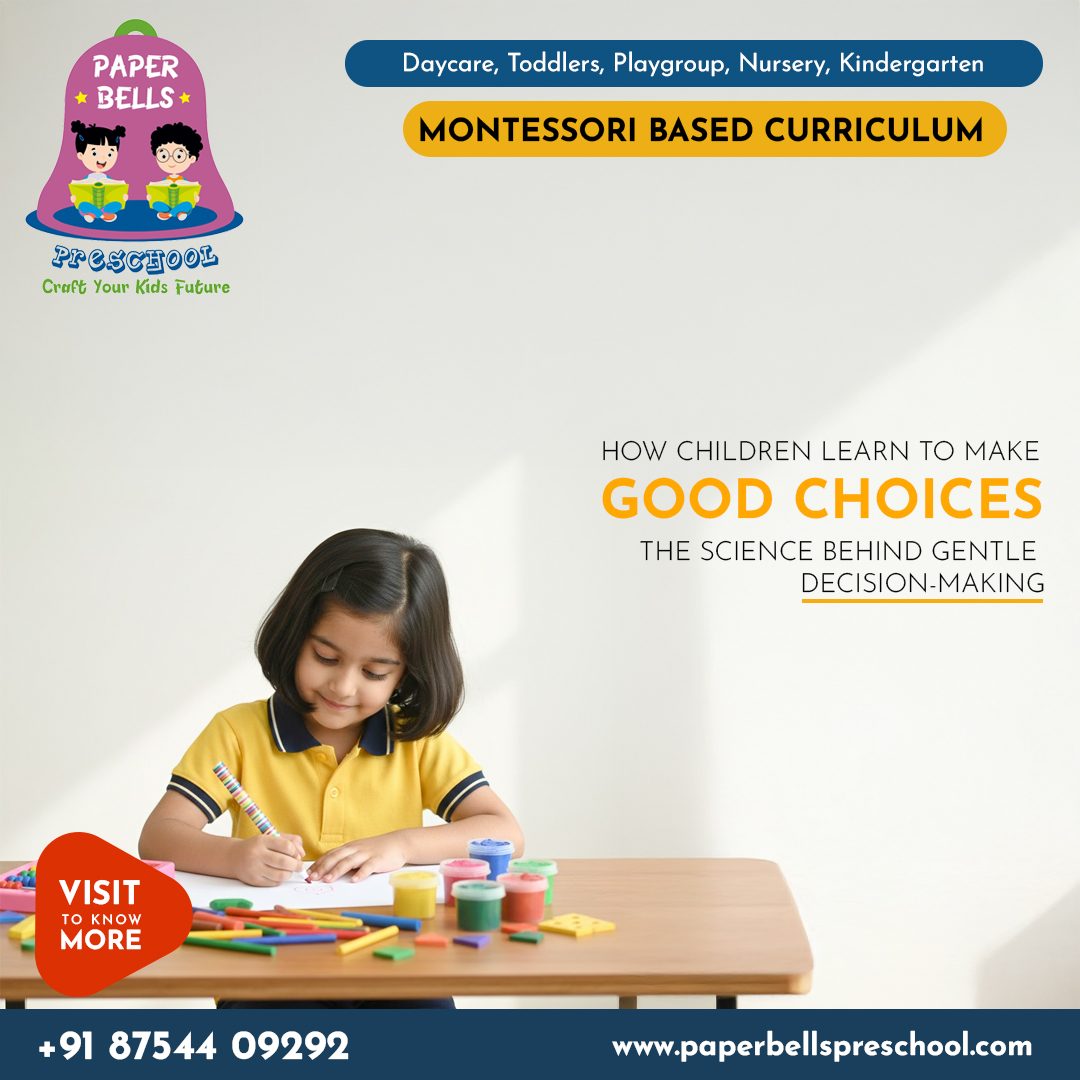
A Paperbells Preschool – Hebbal Perspective
Every parent hopes their child will one day grow into someone who makes thoughtful decisions-someone who can pause, evaluate, and choose the option that matches both their needs and their values. But this ability doesn't magically appear in adolescence. It doesn't emerge in primary school either. It begins much earlier, quietly forming in the preschool years when children are just starting to explore the world with curiosity, confidence, and a deep desire to understand how things work.
At Paperbells Preschool, Hebbal, one of the premium preschools in the area, we approach decision-making as a developmental journey. We see it as something that unfolds gradually, shaped by environment, guidance, autonomy, and everyday interactions. When young children make choices, they are not simply picking between two crayons or selecting which puzzle to attempt. They are practicing judgment, self-regulation, focus, and early reasoning-skills that will influence everything from academic learning to friendships to emotional resilience.
This blog is a gentle exploration of how young children learn to make "good choices", why our environment plays a crucial role, and how teachers guide decision-making without pressure, comparison, or force. We want parents to understand the subtle science behind it, and the equally thoughtful art of creating classroom environments where choices are meaningful rather than overwhelming.
The Foundation of Choice: Why Preschool Is the Ideal Place
Preschool is the first environment where children regularly make decisions that have real outcomes. At home, many choices are structured around family routines. In a preschool environment, however, children learn to navigate options independently-both in learning activities and in social interactions.
What makes Paperbells Preschool, Hebbal unique is the way choice is woven into the rhythm of the day. It is never a rushed decision; it is always a guided one. Whether a child chooses a particular learning centre, attempts a puzzle slightly above their comfort level, or selects materials for an art project, we treat these moments as micro opportunities to exercise their growing judgment.
Neurologically, this matters. The part of the brain responsible for decision-making-the prefrontal cortex-develops rapidly during early childhood. This is the period when neural pathways are being carved based on repeated experiences. Every time a child pauses, thinks, evaluates, and chooses, they are strengthening the networks needed for future reasoning, planning, and problem-solving.
This is why preschool matters. This is why guidance matters. And this is why Paperbells invests deeply in environments designed for gentle independence.
Guided Independence: Where Freedom Meets Trust
One of the greatest misconceptions about early childhood is that choice means unlimited freedom. But children thrive not in unlimited freedom, but in structured freedom-spaces where boundaries are clear, expectations are reassuring, and options are carefully curated to match developmental needs.
At Paperbells Preschool, Hebbal, we create the kind of environment where children feel empowered without feeling lost. For example, our activity shelves are arranged intentionally: each level corresponds to both the physical and cognitive abilities of the age group. A child is free to choose, but each option has been selected to encourage growth, success, and manageable challenge.
Teachers play a crucial role here. They observe before guiding. They wait before stepping in. This encourages children to trust themselves, try again, and reflect on the results of their decisions. The goal is never to make a "perfect" choice; it is to make a considered one.
Over time, these repeated experiences build an internal sense of confidence:
?"I can decide for myself."?"I can think through this."?"I can solve this problem."
This confidence becomes the foundation for later academic learning, emotional resilience, and interpersonal maturity.
The Neuroscience of Choice: How the Brain Learns to Think Ahead
Children are not born with the ability to predict consequences or evaluate options. These are learned skills.
When a child selects a picture card that rhymes with the word on the board, chooses the correct puzzle piece after several attempts, or decides to use yellow instead of blue for the sun in their drawing, their brain is actively strengthening several cognitive processes:
Inhibition: pausing before acting?Working memory: recalling what they know?Cognitive flexibility: shifting strategy when something doesn't work?Evaluation: comparing options based on what they understand
At Paperbells Preschool, teachers introduce choices in ways that gently activate these processes. A child who keeps choosing the same activity might be encouraged to explore something new. A child who selects an overly challenging task is guided toward breaking it into smaller steps. A child who is unsure is given reassurance, not answers.
This creates a beautiful balance: the brain is being stretched, but the child feels emotionally safe. And that combination-challenge plus emotional security-is the ideal condition for decision-making development.
Emotion Before Logic: Why Feeling Safe Matters More Than Choosing Right
A child cannot make good choices if they feel pressured, judged, or confused. Emotional security is the foundation for cognitive growth, and this principle guides everything we do at Paperbells Preschool.
Teachers use gentle language that reassures rather than instructs. They model calm thinking. They acknowledge children's feelings when choices feel overwhelming. And most importantly, they never rush a child into a decision.
When a child feels respected, they begin to think more clearly. They understand that choices have outcomes, not "punishments". They recognise that mistakes are stepping stones, not setbacks. They internalise the idea that decisions can be revised, adjusted, and improved.
This mindset is the essence of developing judgment, not just decision-making.
Choices in Learning: Where Judgment Begins to Take Shape
One of the most important aspects of decision-making is the ability to evaluate options based on purpose rather than preference. While simple choices like "Which colour do you want?" matter, it is in learning activities that children begin to think more deeply.
At Paperbells, teachers design opportunities for decision-making within academic play:
Choosing the right puzzle piece based on shape or pattern trains early analytical thinking.?Selecting the correct word card from a set strengthens cognitive discrimination.?Deciding which material will best complete their picture fosters early planning.?Choosing the correct block to balance a tower supports physical and logical reasoning.
In each of these moments, the child is not merely "doing an activity". They are practising the foundational steps of good decision-making: identifying a goal, evaluating options, predicting outcomes, trying, adjusting, and trying again.
These are the very skills that later support mathematics, language learning, problem-solving, and real-life decision-making.
The Teacher's Invisible Hand: Gentle Guidance Without Taking Over
Children learn to make good choices not by always being right, but by being guided through the process. The teachers at Paperbells Preschool are trained to support autonomy without overshadowing it.
They might sit beside a child attempting a tricky task but allow the child to lead.?They might ask a thought-provoking question instead of giving a solution.?They might narrate a child's thought process gently, helping them become aware of their own reasoning.?They might encourage reflection: "What do you think will happen if you choose this one?"
This kind of teaching is subtle, almost invisible. But it plays a powerful role in shaping the child's ability to reason independently.
The goal is not compliance. It is clarity.
Learning to Own Decisions: The Power of Natural Consequences
In a preschool context, natural consequences are safe, gentle, and deeply educational. If a child chooses a block that is too small, the tower may wobble. If they choose the wrong letter tile, the word won't match the picture. If they choose to skip an easier activity, they may find the next one more challenging.
At Paperbells Preschool, children never feel ashamed of these outcomes. Instead, they experience them with curiosity and growing self-awareness.
They learn that their actions create results.?They learn that thinking helps prepare them.?They learn that choices matter-not because of external approval, but because of internal understanding.
This is decision-making in its purest, most formative form.
The Long-Term Impact: How These Early Lessons Shape Future Learners
When children practice making thoughtful choices in their early years, they develop a lifelong foundation for:
academic independence?problem-solving?empathy?time management?self-regulation?responsibility
A confident decision-maker in preschool often becomes a responsible learner in primary school, a reflective student in adolescence, and eventually, an adult who approaches life with clarity and calm.
This is the deeper purpose behind our decision-rich environment at Paperbells Preschool, Hebbal. We want children to grow not only in knowledge but in wisdom-the kind of wisdom that begins when they learn to trust their own judgment.
Good Choices Are Not Taught. They Are Gently Built.
At Paperbells Preschool – Hebbal, we believe that good decision-making is not something imposed on children-it is something cultivated through patient guidance, thoughtfully designed environments, and countless everyday opportunities that strengthen judgment and independence.
Children grow into good thinkers when adults give them space to think.
?They grow into good decision-makers when adults trust them enough to choose.?They grow into confident learners when they feel respected, supported, and understood.
This is what we strive for every day. This is the heart of our preschool philosophy. And this is why families across Hebbal choose Paperbells-not just for education, but for gentle growth, meaningful independence, and lifelong confidence.


