
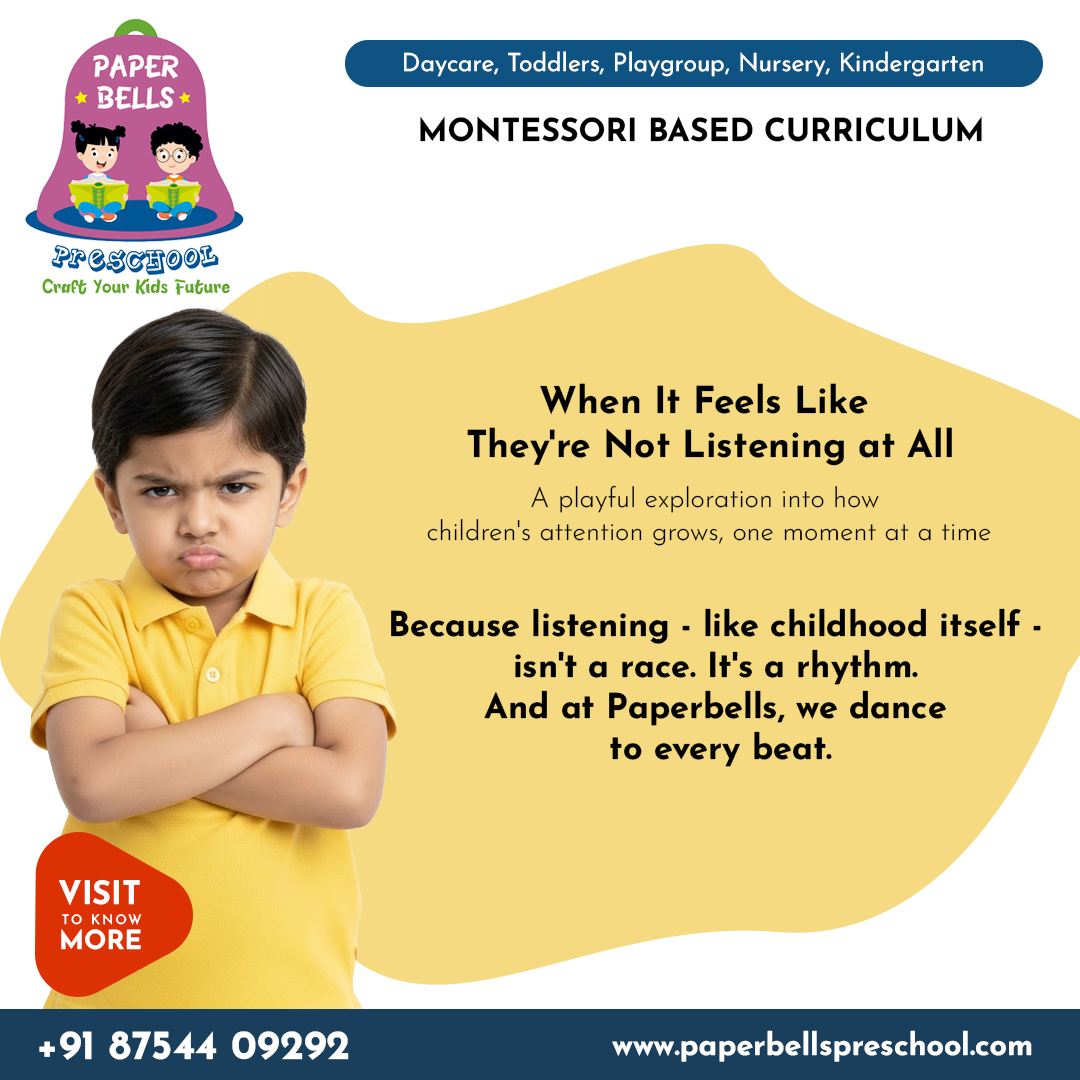
A playful exploration into how children's attention grows, one moment at a time
When It Feels Like They're Not Listening at All
Every parent has been there - you're halfway through asking your child to put on their shoes, and they're busy staring at a line of ants marching across the floor. You ask again, a little louder this time. Still no response. You finally get their attention, only to be met with the widest, most innocent eyes that seem to say, "Oh! Were you talking to me?"
It's easy to mistake moments like these as defiance or distraction, but what's really happening inside your preschooler's mind is far more fascinating - and far more natural - than it appears.
At Paperbells Preschool, a premium chain of preschools in Hebbal, we often reassure parents that 'not listening' isn't a sign of indifference or stubbornness. It's actually a window into how young brains develop focus, process information, and manage the exciting world around them. Understanding this process can transform everyday frustrations into moments of empathy, connection, and growth.
Tiny Brains, Big Jobs
Imagine standing in the middle of a carnival - bright colours, music, voices, balloons, smells of popcorn, all happening at once. Now imagine trying to focus on one single sound amidst it all. That's what life often feels like for a preschooler.
At this age, children are just beginning to refine their working memory - the mental notepad that helps them hold on to information long enough to use it. When you say, "Please put your toys away, wash your hands, and come to the table," you're actually giving a young brain a three-step plan that's far more complex than it sounds.
For a child whose neural pathways are still being formed, that's a marathon of processing. They might remember toys… and halfway through, a stray crayon reminds them of a drawing they wanted to finish. Before long, the grand plan of washing hands and heading to the table has vanished - replaced by another bright idea.
This isn't inattentiveness. It's learning in action.
Listening Is a Skill, Not an Instinct
Adults often forget that listening isn't automatic - it's a layered skill that takes years to mature. For preschoolers, "listening" means more than just hearing words. It involves filtering background noise, processing language, connecting it to meaning, remembering what was said, and then deciding how to respond - all within seconds.
At Paperbells Preschool, Hebbal, our educators view listening as something that blossoms gradually, through rhythm, play, and real engagement. Storytime sessions are filled with animated expressions, soft pauses, and interactive questions. Circle time conversations aren't lectures - they're gentle invitations to tune in and take turns.
Through these small, consistent moments, children begin to understand the joy of listening - not as obedience, but as connection.
What's Happening Inside Their Brains
From a neurological standpoint, the parts of the brain that regulate attention and impulse control - particularly the prefrontal cortex - are still under construction in preschoolers. This region is responsible for executive functions like planning, focus, and emotional regulation.
This means that when a teacher says, "Let's line up for snack time," a child might hear the words but not yet have the brain circuitry to shift attention smoothly from one activity to another. Instead, they pause, they linger, or they continue building that last block tower - not out of rebellion, but because their brain is still learning how to switch gears.
At Paperbells, we see this as a developmental rhythm, not a behavioural flaw. Patience and repetition are our tools. Each time a child practices pausing, redirecting, or responding to gentle reminders, those neural connections grow stronger - like pathways being paved through a dense forest.
The Playful Art of Attention
Children don't learn focus through commands; they learn it through curiosity. When they're drawn into a story, a song, or a game, they're naturally practising the art of sustained attention.
That's why at Paperbells Preschool, Hebbal, learning is woven with laughter. Our classrooms hum with playful discovery - from listening games that encourage turn-taking, to story circles where children predict what comes next, to rhythm activities that build auditory memory.
We treat focus like a muscle. The more joyfully it's used, the stronger it becomes.
And in between, we make space for the wobbles - the moments when attention drifts away to a butterfly outside the window or a friend's giggle across the room. Those are reminders that curiosity still leads the way - as it should, in early childhood.
What Parents Can Do at Home
The key is not to demand perfect listening, but to nurture it with warmth and patience. Here's how parents can support what's already happening at school:
Get down to their level: Eye contact helps bridge attention.
Say less, mean more: Short, clear instructions are easier to process.
Give time: Wait a few seconds after asking - young brains need that pause to catch up.
Celebrate small wins: Acknowledge every little moment of cooperation - it builds motivation to keep listening.
Model listening: When you show interest in what your child says, they learn the beauty of being heard.
At Paperbells, we often remind families that children mirror what they experience. When they feel truly listened to, they begin to extend that same gift to others.
Every Brain Blooms at Its Own Pace
One of the joys of working in early childhood education is witnessing how differently children unfold. Some are eager responders - their hands shoot up before a question even ends. Others prefer to take in the world quietly, piecing together their thoughts before they speak. Both are growing beautifully - just in different rhythms.
At Paperbells Preschool, Hebbal, we honour those rhythms. Our classrooms are calm yet vibrant, structured yet flexible. Teachers learn to read the subtle cues - the thoughtful child who watches before joining, the chatterbox who needs gentle redirection, the dreamer whose focus blossoms in bursts of creativity.
Each of these patterns is a glimpse into a developing mind - and all are worth celebrating.
The Paperbells Philosophy: Listening Beyond Words
We believe that listening goes both ways. As educators, we listen to children - to their silences, their laughter, their body language, and their curiosity. We create an atmosphere where children feel safe to respond, to try, and to make mistakes without fear.
Because when children feel heard, they begin to hear in return.
Our approach at Paperbells is grounded in understanding - not correction. Every missed instruction is a moment to connect, not a failure to discipline. Every child learns that attention isn't about perfection; it's about growing awareness, both of themselves and the world around them.
In the End, They Are Listening - Just Differently
So the next time your little one seems lost in thought when you call their name, remember: their mind might be busy sorting, storing, and processing the wonderful chaos of early learning. Their ears hear you - their brain just needs a little more time to catch up.
At Paperbells Preschool, Hebbal, we believe in giving children that time. We nurture patience, foster joy, and create the quiet confidence that helps every child tune into the world in their own way.
Because listening - like childhood itself - isn't a race. It's a rhythm. And at Paperbells, we dance to every beat.


