
Where Every Sense Becomes a Pathway to Learning
If you ever watch a preschooler move, dance, or explore, you'll notice something extraordinary - they're not just "playing." Their bodies are learning. Their senses are gathering information, making connections, and shaping meaning from the world around them. Every step, every hum, every splash of paint or tap on a drum is part of the brain's magnificent process of understanding.
At Paperbells Preschool, a premium preschool in Hebbal, this philosophy forms the heartbeat of our approach. We see early learning as something that happens not only in the mind - but through the body, through rhythm, through touch, and through movement. Ours is a space where the classroom hums with sound, motion, and discovery - not chaos, but the quiet, intelligent rhythm of children making sense of their world.
The Science Behind Sensory Learning
Children aren't meant to sit still. Neuroscientists have found that young brains develop through sensorimotor experiences - meaning that movement, sound, and touch work together to form neural pathways that support memory, focus, and problem-solving.
When a child claps along to a song, balances on a beam, or traces shapes in sand, their brain is doing far more than just "having fun." It's organizing information, strengthening connections between the senses, and building the foundation for literacy, numeracy, and emotional understanding.
At Paperbells, we embrace this science wholeheartedly. Each learning experience - whether it's a music circle, a movement game, or a tactile art session - is designed to engage multiple senses. The result? Children who don't just remember information but understand it, feel it, and live it.
Movement: The Body's Language of Thought
Before children can write, they draw. Before they draw, they move. Movement is the very first language through which young children express thought.
Our classrooms are not bound by desks and chairs - they are open, flexible spaces that invite motion. Children hop, twirl, and stretch as they learn new sounds or act out a story. In our outdoor play zones, every step, jump, and climb builds coordination, balance, and spatial awareness - the same skills that later support writing, reading, and even logical reasoning.
A morning at Paperbells might begin with music and movement - tiny feet tapping to rhythm, bodies swaying, hands clapping in unison. But beneath the laughter and motion lies something remarkable: the development of executive function - the brain's ability to plan, control impulses, and focus attention.
Movement teaches regulation, timing, and control - but in a way that feels joyful and natural. It's learning without pressure, guided by rhythm and curiosity.
Music: Where Sound Becomes Emotion and Understanding
Music has a language all its own - and for children, it's one of the first languages they understand intuitively. The steady beat of a drum, the rise and fall of melody, the repetition of rhyme - all these elements train the brain to recognize patterns, build memory, and anticipate what comes next.
In our music sessions, children don't just listen - they participate. They sing, experiment with instruments, and create soundscapes that connect emotion with rhythm. Through these moments, they learn sequencing, vocabulary, and emotional expression - all while building confidence and joy.
Recent studies show that music enhances the neural networks responsible for math and language. At Paperbells, we see this play out daily: the child who once hesitated to speak now sings gleefully; the one who found counting difficult now taps rhythm patterns with ease. Music, for us, is not an "extra" - it's a bridge between heart and mind, emotion and intellect.
Touch: The First Teacher of Trust and Curiosity
Long before children can read or write, they feel their world. Touch teaches texture, shape, and temperature - but it also teaches something deeper: connection.
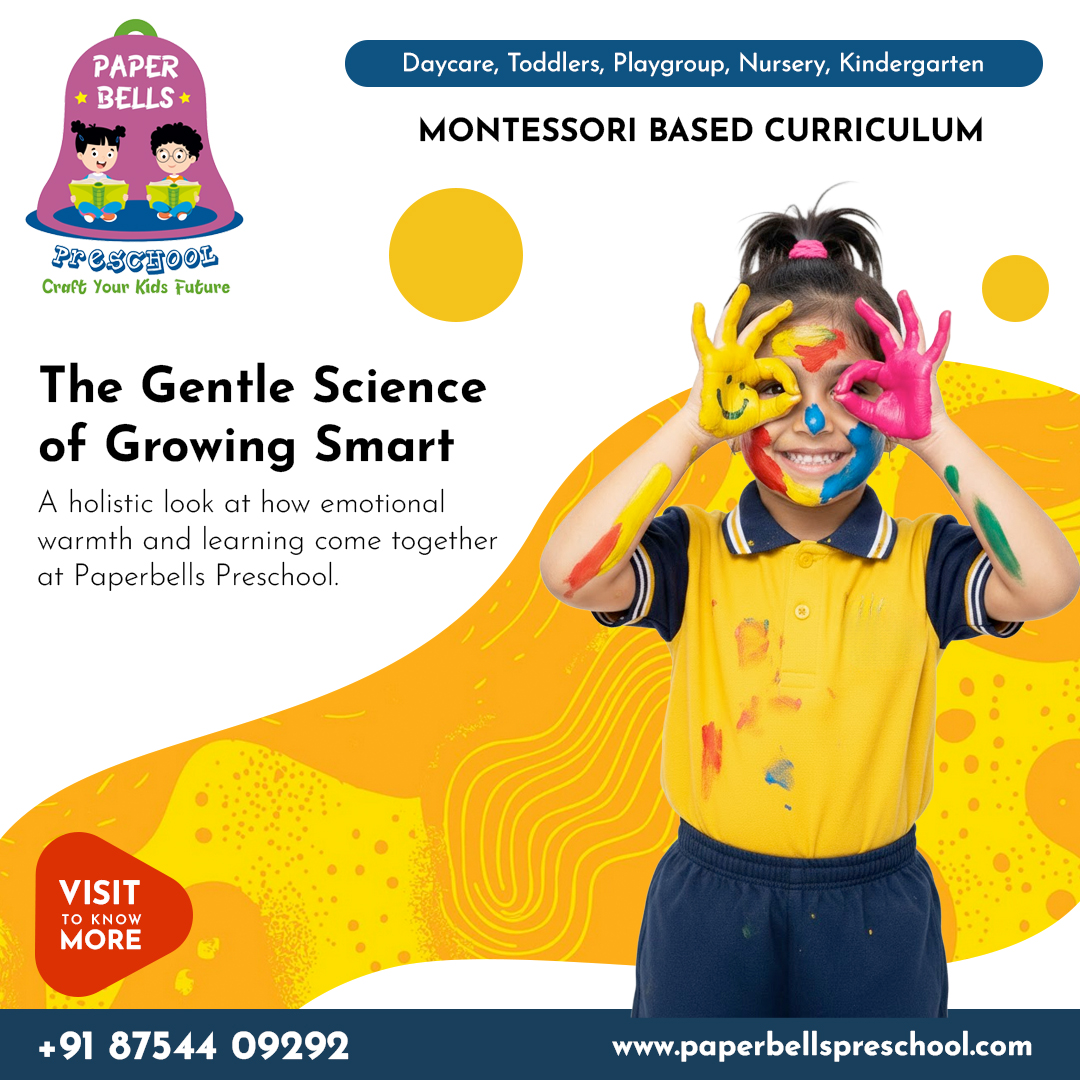
In our classrooms, tactile learning is everywhere. Children dig their fingers into clay, sort shells and stones, and explore materials of all kinds - smooth, rough, cool, warm. These experiences awaken curiosity, sharpen observation, and foster comfort with exploration.
Touch is not just sensory - it's emotional. When a teacher gently guides a child's hand, or when children hold hands in a circle game, the brain registers safety and belonging. These subtle moments of connection are the foundation of trust - and trust, in turn, opens the door to true learning.
We often say at Paperbells: hands busy, minds open. And it's true - when children manipulate, explore, and engage through touch, they're building both skill and confidence, one texture at a time.
The Multisensory Classroom: Learning Through Layers
Our classrooms in Hebbal are designed to be multisensory environments - not overwhelming, but richly layered. You might see a group of children counting coloured beads while tapping rhythms, another painting to music, and another tracing letters in sand.
Each activity activates multiple regions of the brain, reinforcing learning through different channels. This integrated approach means that no two children need to learn the same way - every sense can be a pathway.
A child who learns best through movement can jump through number lines. A child drawn to music can sing through story sequences. A tactile learner can sculpt letters out of dough. The goal isn't to make children fit a single method - it's to make learning fit the child.
Emotion and Empathy in Every Experience
One of the most beautiful effects of multi-sensory learning is how it shapes emotional intelligence. When children express themselves through music or movement, they're learning to recognize and manage feelings - both their own and others'.
Our teachers are trained to respond to these emotional cues with sensitivity. A hesitant dancer might be encouraged with rhythm sticks instead of a spotlight. A shy speaker might find confidence through a soft drumbeat that gives voice to emotion.
Through this kind of attuned teaching, children begin to connect feeling with understanding - a skill that builds empathy. They start to see that everyone moves, feels, and learns differently - and that difference is something to celebrate.
Where Science Meets Wonder
Behind every sensory-rich activity at Paperbells Preschool lies careful thought. We align joyful play with early neuroscience - ensuring that every song, game, and creative exercise serves a purpose beyond entertainment.
Yet, we never let science overshadow wonder. Because while we understand the developmental reasoning behind sensory play, we also know that the child doesn't need to. To them, a bucket of water isn't about coordination - it's about splash and laughter. A rhythm stick isn't about math - it's about joy.
Our role as educators is to preserve that joy while ensuring that every giggle, splash, and stomp contributes to something lasting - neural growth, emotional intelligence, and lifelong curiosity.
The Heart of Our Approach
At Paperbells Preschool in Hebbal, our goal is to raise children who are not only intelligent but deeply connected - to themselves, to others, and to the world around them.
We believe that early learning should feel like an orchestra - where senses, emotions, and curiosity play in harmony. Movement is the rhythm, music is the melody, and touch is the grounding note that brings it all together.
Every day, our classrooms echo with the sound of learning - not memorization, but meaning-making. Each sensory experience is a brushstroke in a larger masterpiece - the growing mind of a confident, curious, and compassionate child.
A Place Where Learning Feels Alive
When parents walk into Paperbells, they often remark on the "feel" of the place - the warmth in the air, the soft hum of laughter, the rhythm of activity that feels calm yet alive. That's the essence of what we nurture here - learning that's felt, not forced.
Because education, especially in the early years, is not about filling a child with facts. It's about awakening a sense of wonder, grounding them in security, and helping them experience the world with every sense available.
And that's exactly what we do - each song, each movement, each gentle touch guiding a child toward understanding not just the world around them, but the one within.
At Paperbells Preschool in Hebbal, we don't just teach children to learn - we help them feel, move, and grow into thinkers who see beauty in the details, rhythm in the everyday, and meaning in every sense.


