
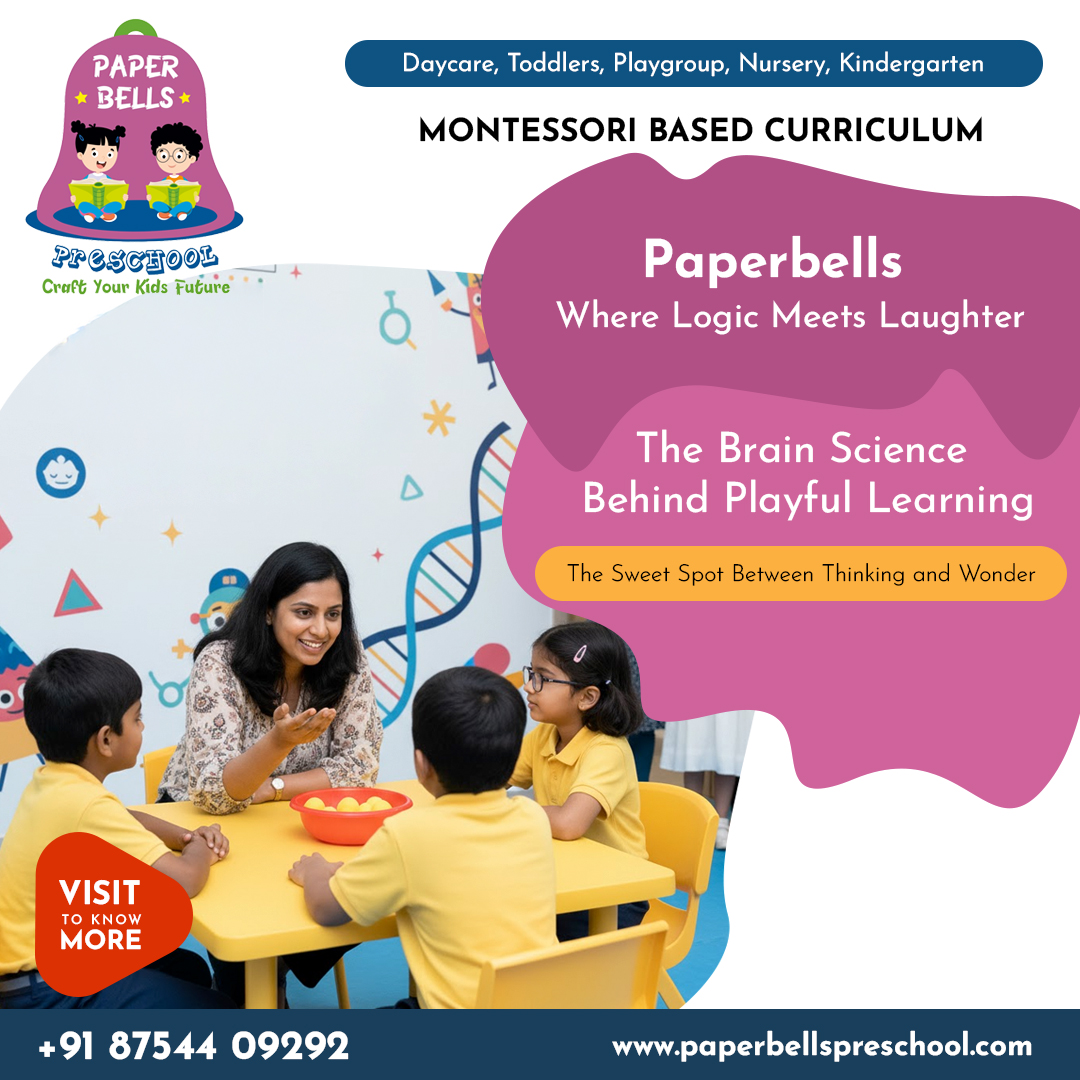
The Sweet Spot Between Thinking and Wonder
If you've ever watched a child stack blocks, pour sand, or giggle over a pretend tea party, you've witnessed something extraordinary. It might look like play - and it is - but behind every laugh and curious glance, the brain is hard at work. It's sorting, predicting, testing, and learning. At Paperbells Preschool in Hebbal, we often say that the most powerful classrooms don't always sound quiet. They buzz, hum, and sometimes erupt in laughter - because that's where learning truly begins.
Play, after all, is not the opposite of learning; it is learning, disguised as joy. And when logic and laughter meet, the result is a kind of understanding that lasts far beyond the preschool years.
Why the Brain Loves to Play
Science tells us that a child's brain is wired for play. From birth to age five, neural connections form faster than at any other time in life - about one million new connections per second. Every playful moment - every puzzle solved, block tower built, or rhyme sung - strengthens those pathways.
When children play, they're not only engaging their imaginations but also training their brains to think critically, plan ahead, and adapt to change. The brain releases dopamine during moments of joy and curiosity, a chemical that fuels attention and memory. Simply put, when children are happy, they learn better.
At Paperbells Preschool, this understanding shapes everything we do. Whether children are exploring patterns through music, experimenting with colours, or engaging in group games, each playful moment is deliberately designed to nurture both intellect and emotion.
The Magic of Playful Logic
There's a fascinating bridge between laughter and logic - a point where creativity meets cognition. For instance, when children engage in role play ("Let's pretend we're shopkeepers!"), they're practising decision-making, language development, and empathy. When they build with blocks, they're exploring geometry, balance, and cause and effect - without ever realising they're doing "math."
This is what we mean by playful logic - learning that's not imposed but discovered. At Paperbells Preschool, activities are crafted to spark both sides of the brain. Logical thinking thrives in an atmosphere of joy and exploration, while creative play is gently structured to build reasoning skills. It's a dance between imagination and intelligence - where every giggle carries meaning.
The Neuroscience of Joyful Learning
The connection between joy and learning runs deep. When a child experiences happiness or curiosity, the brain's limbic system becomes more active. This emotional engagement helps store new information in long-term memory. In simpler terms, children remember best when they feel good.
That's why at Paperbells Preschool in Hebbal, our classrooms are designed to be vibrant, inviting, and alive with sensory experiences. From tactile learning corners to rhythmic storytelling sessions, every detail is intended to evoke joy - because joy isn't just a feeling; it's a learning catalyst.
When children play freely, their stress hormones drop, and their focus improves. Their neural circuits associated with planning, sequencing, and emotional control get stronger. And as educators, we see the proof daily - in the child who begins to solve problems independently, in the one who learns to cooperate with peers, and in the one who proudly explains the rules of a game they've just invented.
Turning Curiosity into Knowledge
Play transforms curiosity into understanding. When a child asks "Why does this sink?" or "What happens if I mix these colours?" they're doing what scientists do - forming hypotheses, testing them, and learning from the outcome.
At Paperbells, our teachers don't simply answer; they guide. Instead of saying, "This is how it works," they say, "What do you think might happen?" That one small shift - from instruction to invitation - makes a world of difference. It teaches children to think for themselves, to see mistakes as experiments, and to associate learning with joy rather than pressure.
The Role of Teachers: Playful Guides, Not Instructors
In a world where structured learning often overshadows imagination, the teachers at Paperbells Preschool play a beautifully balanced role - that of facilitators, not lecturers. They observe, listen, and gently weave concepts into play.
A sandpit becomes a lesson in volume and texture. A game of "pretend kitchen" transforms into a vocabulary builder. Counting toys becomes a rhythm exercise. But through it all, laughter remains constant - because at Paperbells, we know that learning sticks when it's wrapped in emotion.
Our educators are trained to recognise the teachable moments hidden in play - the fleeting seconds when a child's curiosity peaks, or when they share, negotiate, or problem-solve. Those are the moments that shape lifelong learners.
Building Brains Through Joy
Children's brains thrive on patterns of exploration. Each time they play, they're not just expressing creativity - they're wiring logic, sequencing, memory, and self-regulation. A game of hide and seek, for example, requires planning, impulse control, and memory recall. Building a tower teaches spatial reasoning and patience. Singing together fosters rhythm and language comprehension.
What ties all of these together is joy. Neuroscientists often say, "Emotion drives attention, and attention drives learning." This is why the environment at Paperbells Preschool is intentionally warm and stimulating. When children laugh, move, and express freely, they're not being distracted - they're developing.
The Social Side of Smart Play
Play isn't a solo act. It's deeply social. Through play, children learn how to communicate, collaborate, and empathise. They navigate rules, negotiate turns, and develop the emotional intelligence that no worksheet can teach.
At Paperbells, group activities - from storytelling circles to music sessions - are opportunities to build community and character. Laughter becomes a shared language, helping children feel connected and confident. These early experiences of social belonging lay the groundwork for emotional health and leadership later in life.
The Classroom That Thinks Like a Playground
Step into any Paperbells Preschool classroom in Hebbal, and you'll notice something different: learning doesn't sit still. Children move, explore, and interact with materials that invite curiosity. Our environments are thoughtfully designed to bridge logic and laughter - bright, tactile, and responsive to children's energy.
A child building a bridge out of blocks is learning basic engineering. A storytelling corner might turn into a spontaneous drama session that strengthens vocabulary and confidence. Even art time is infused with logic - patterns, sequences, and problem-solving hidden beneath the paint and glitter.
We believe that when children play with purpose - joyfully, imaginatively, and freely - they don't just learn faster. They learn deeper.
Parents as Partners in Playful Learning
The spirit of playful learning doesn't end at school gates. At Paperbells, we see parents as partners in extending this joy into everyday routines. Setting the table, sorting laundry by colour, baking together - all these are playful logic moments waiting to happen.
We often remind parents that what matters most isn't the "correct" way to play but the shared laughter, the curiosity, and the small discoveries that follow. Children thrive when they see learning as a part of living - not a task, but a joy.
By keeping play alive at home, families reinforce what we cultivate at school - a love of learning that's natural, lifelong, and rooted in curiosity.
Why Joy Is the Most Serious Kind of Learning
In education, it's easy to overvalue seriousness - neat worksheets, perfect handwriting, quiet classrooms. But research consistently reminds us that joy, not rigidity, builds lasting intelligence. A happy brain is a thinking brain.
At Paperbells Preschool, we take this truth to heart. Every activity, routine, and conversation is designed to blend fun with focus. We don't separate laughter from learning - we bring them together so that one strengthens the other.
Because the goal isn't just to raise bright children. It's to nurture thinkers who approach challenges with curiosity, creativity, and courage - the kind of thinkers who will grow into compassionate problem-solvers in the world beyond preschool.
A Final Note from Paperbells Preschool
Play may look simple, but within it lies the most sophisticated kind of learning. It's where logic sharpens and laughter softens, where the brain and the heart grow side by side.
At Paperbells Preschool - a premium chain of preschools in Hebbal - we celebrate this balance every day. Here, children learn not just through books, but through joy. Not just through instruction, but through discovery. Because we believe that when logic meets laughter, the result is not only learning - it's lifelong love for it.


