
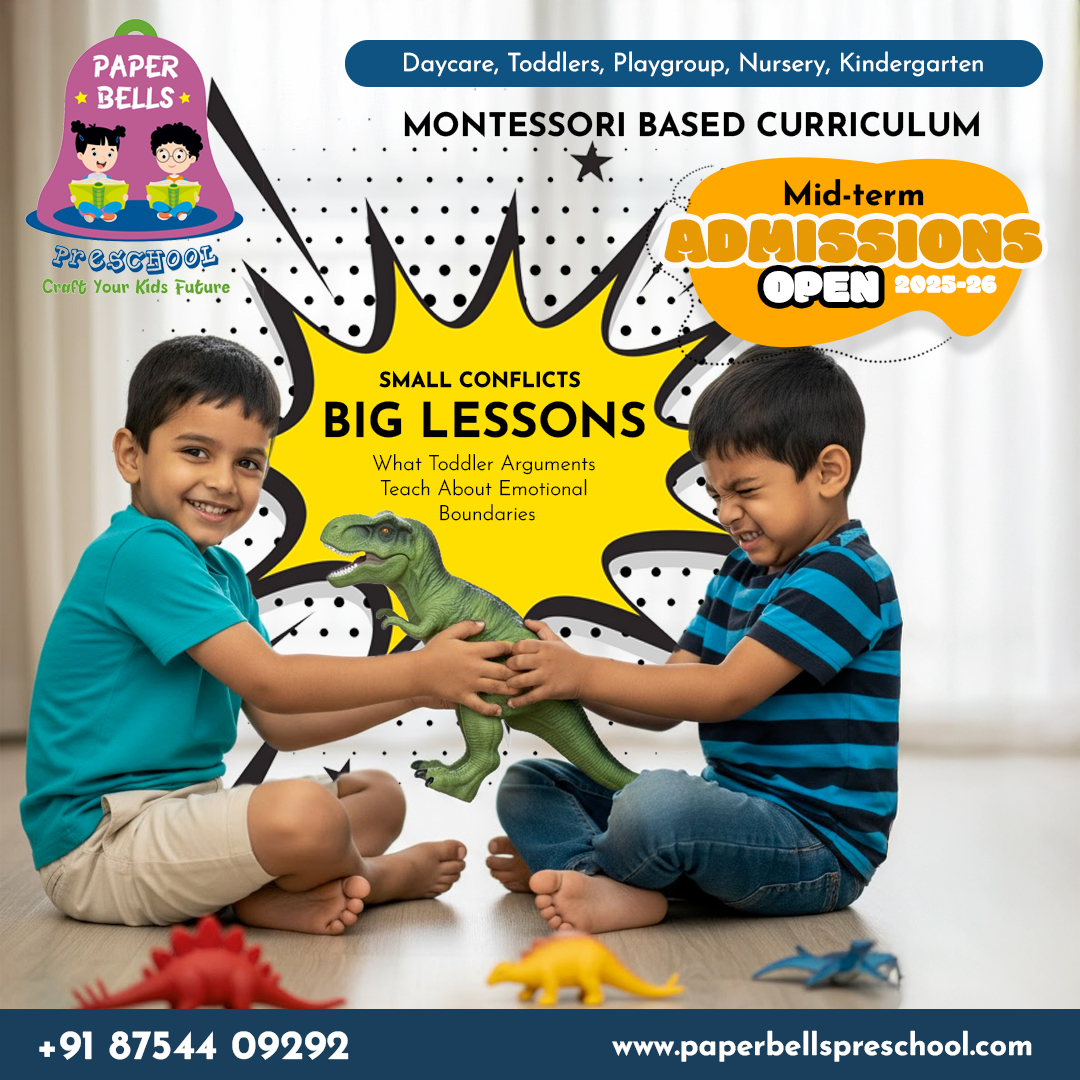
The Surprising Power of a Toddler's "No!"
At first glance, a preschool room buzzing with chatter, laughter, and the occasional argument might seem like chaos. A toy disputed between two children, a tug-of-war over a crayon, or a defiant "It's mine!" can make adults instinctively step in to resolve the tension. Yet, beneath these small disagreements lies something profoundly beautiful - the early formation of emotional intelligence.
At Paperbells Preschool, Hebbal, we see these moments not as disruptions, but as opportunities. Every squabble, every pout, and every small act of negotiation carries within it the seeds of empathy, resilience, and social understanding. When guided gently and intelligently, toddler arguments can become some of the most powerful lessons in emotional boundaries.
In fact, learning how to disagree - and do it with heart - is one of the earliest signs of emotional growth.
From Disagreement to Discovery
Before children learn how to spell their names or count to ten, they begin to understand the concept of "self" and "other." Around the ages of two to four, toddlers enter a stage where independence and self-expression bloom rapidly. They begin to realise that their feelings, choices, and desires are distinct from others'.
This is where conflict naturally appears. A child doesn't snatch a toy simply because they are "being difficult" - they are, in fact, exploring the boundaries of identity and ownership. They are discovering what it means to want something, to communicate it, and to negotiate its outcome.
At Paperbells Preschool in Hebbal, we view these early conflicts as important emotional rehearsals. Just as children need to fall and get back up to learn balance, they need small disagreements to learn cooperation. Each emotional stumble becomes a step toward emotional maturity.
The Science of Small Conflicts
Psychologists often describe conflict as "the birthplace of empathy." When two children argue, their brains engage in complex processing. They are assessing fairness, interpreting tone, reading facial cues, and trying to assert themselves - all simultaneously.
The neural circuits for empathy, emotional regulation, and social reasoning are firing actively in these moments. Through repeated experiences, the brain learns to manage frustration, understand another's perspective, and make sense of social boundaries.
In our classrooms at Paperbells Preschool, these experiences are not left to chance. Teachers guide interactions with patience and awareness, helping children identify their emotions ("You feel upset because he took your block") and suggesting words or actions that express them constructively. Slowly, the child begins to connect feelings to language, impulses to understanding - and chaos turns into communication.
Guided, Not Suppressed: The Art of Gentle Mediation
One of the cornerstones of our teaching philosophy at Paperbells Preschool, Hebbal, is to guide, not suppress emotion. When adults rush to silence conflict, children miss a vital developmental opportunity. But when educators model calm reasoning and help children express their feelings respectfully, they learn emotional literacy - the skill of reading and managing emotions.
Imagine two children fighting over a ball. A quick "Stop fighting and share!" might quiet them for the moment, but it doesn't teach them how to handle frustration. Instead, we encourage teachers to kneel down to eye level and guide the conversation:
?"Let's think - how can we both play?" or "Would you like to take turns?"
This approach does more than solve the issue; it reinforces emotional independence. The children learn that their feelings matter, but so do others'. It's this subtle shift - from control to communication - that nurtures lasting empathy.
Boundaries: The First Lessons in Respect
When a toddler says, "No, that's mine," they are doing more than asserting ownership - they're establishing boundaries. And boundaries, even in their simplest form, are essential to developing respect, safety, and self-worth.
At Paperbells Preschool, we teach that having boundaries is not about being stubborn or selfish; it's about understanding comfort and consent. When a child learns to say "no," they are also learning how to hear and respect another's "no." This reciprocity becomes the emotional architecture for healthy relationships throughout life.
Our educators help children recognize and respect these invisible borders by reinforcing language like, "Let's ask before taking," or "She's not ready to share right now - that's okay." Over time, these gentle cues shape a culture of emotional respect and awareness.
Turning Tantrums into Teachable Moments
Even the best-guided conflicts sometimes end in tears - and that's all right. Tantrums are often the child's way of expressing what their words can't yet articulate. What's important is not to avoid them, but to respond with attuned empathy.
At Paperbells Preschool in Hebbal, we approach such moments with composure and understanding. Our teachers don't simply hush a crying child; they validate the emotion behind it. They say, "I can see you're angry because you wanted to keep the toy. That's okay to feel." This recognition of emotion helps children internalize that feelings aren't wrong - but they must be expressed in a way that considers others too.
Through repeated guidance, children learn that emotions are not to be feared or hidden - they are signals to be understood. This emotional literacy forms the foundation for emotional boundaries: knowing what we feel, why we feel it, and how to express it safely.
Conflict and Cooperation: Two Sides of the Same Coin
Children who learn to navigate conflicts also learn the deeper meaning of cooperation. Once they experience the satisfaction of resolving a disagreement together - of turning "mine" into "ours" - they build a sense of collective achievement.
At Paperbells Preschool, group play and shared projects are designed to balance individuality with teamwork. Whether children are building a block tower together, painting a mural, or preparing for a class performance, they encounter moments of negotiation. These shared creative experiences teach patience, adaptability, and understanding - qualities that grow naturally from resolving conflict with empathy.
Over time, these children develop what psychologists call social flexibility - the ability to hold their ground while still valuing others' perspectives. It's the earliest form of leadership and collaboration.
The Role of Environment in Emotional Growth
A well-designed preschool environment doesn't just support learning - it shapes emotional behaviour. At Paperbells Preschool in Hebbal, every corner of the classroom is curated to encourage self-expression and mutual respect.
From art corners where children express feelings through colour, to story circles where they share experiences, every activity is infused with emotional meaning. Teachers observe not just what the children create, but how they interact while creating it. When small disputes arise, they are addressed in-the-moment, turning real experiences into teachable opportunities.
Our play zones are intentionally arranged to foster shared spaces rather than competition. Through collaborative play, children learn that joy can be shared and that fairness can feel good. This sense of community nurtures inner calm, social balance, and confidence.
Parents as Partners in Emotional Learning
Emotional growth doesn't stop when the school day ends. At Paperbells Preschool, we work closely with parents to extend these lessons into home environments. Through parent-teacher dialogues and awareness sessions, we share insights into the emotional cues of young children - what certain behaviours mean, how to respond effectively, and how to model empathy at home.
Simple routines - waiting for a turn, listening while someone speaks, or acknowledging another's feelings - can make a profound difference. When school and home reinforce the same emotional principles, children feel safer to explore and express.
This partnership between teachers and parents forms the backbone of our philosophy - emotional development is not taught in isolation; it is cultivated in connection.
Raising Children Who Understand Themselves and Others
At its heart, every disagreement between children is a small step toward emotional wisdom. It's how they learn that their actions have consequences, that others have feelings too, and that kindness can exist even amidst frustration.
At Paperbells Preschool, Hebbal, we nurture this understanding with care, patience, and joy. Our role is not to eliminate conflict but to give children the emotional tools to handle it gracefully. By guiding them through these small moments with empathy and structure, we help shape emotionally intelligent individuals who can navigate the larger world with confidence and compassion.
In these formative years, every "mine" and "no" whispered across the classroom is more than just a disagreement - it's the sound of growing minds learning how to live, love, and coexist.
Where Learning Meets Feeling
In the soft hum of classroom life, between laughter and occasional tears, lies the real work of early education - the building of emotional foundations. When children learn to manage conflict, they are learning to understand themselves. When they learn to listen, they are learning to respect others.
That is the essence of what we believe in at Paperbells Preschool in Hebbal - that every emotional experience, big or small, contributes to the making of a thoughtful, balanced human being.
Because before children learn their ABCs, they are learning how to be - and that, perhaps, is the most important lesson of all.


