
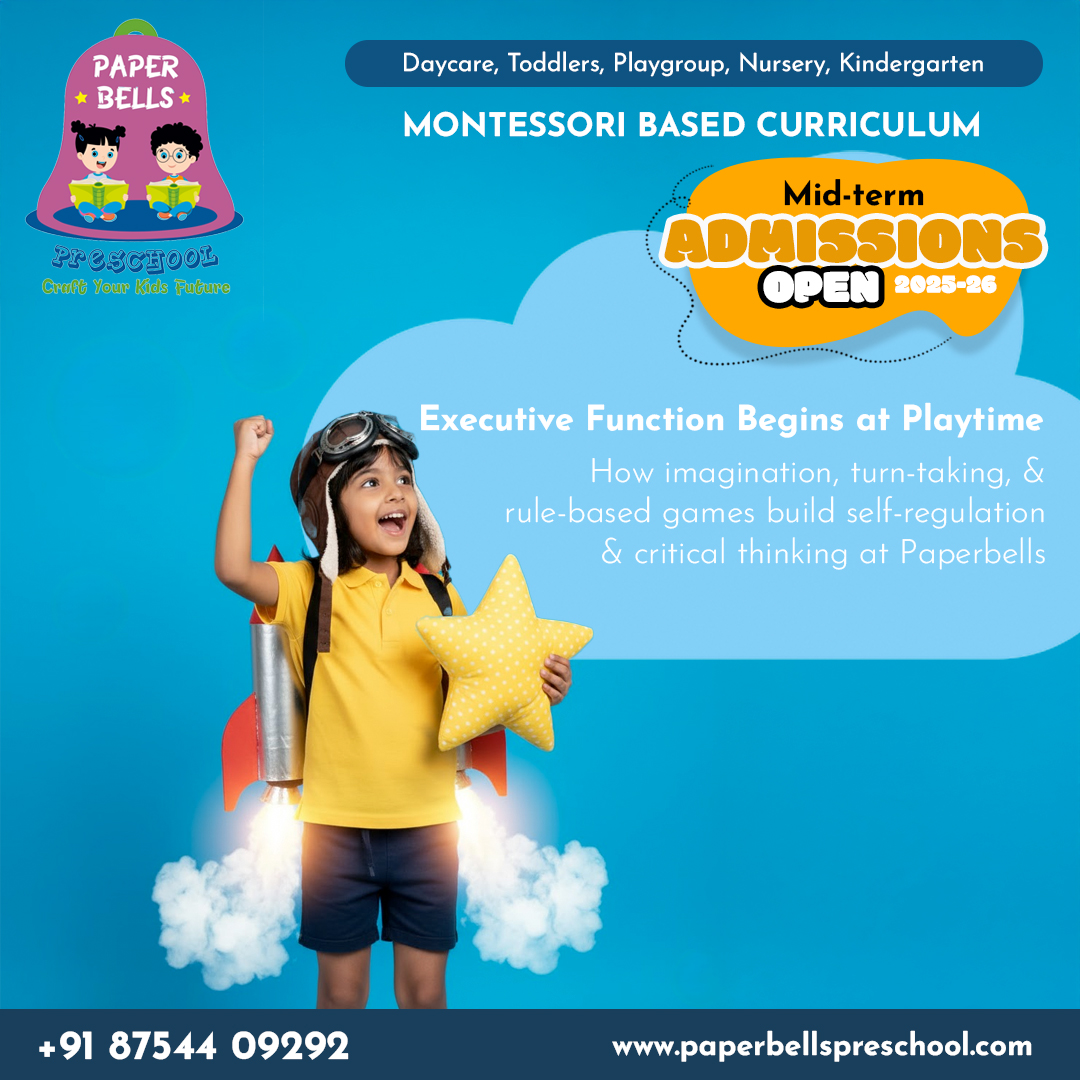
How imagination, turn-taking, and rule-based games build self-regulation and critical thinking at Paperbells Preschool, Hebbal
Step into a Paperbells classroom in Hebbal, and you will witness what seems like ordinary play - blocks stacked into towering castles, a colorful board game drawing a group of eager faces, a dramatic puppet show unfolding in a corner. Yet behind the laughter and movement, something extraordinary is taking place. Every decision, every negotiation, every imaginative twist is quietly training the child's most vital mental muscles: the skills that collectively form executive function.
At Paperbells Preschool, we understand that early childhood is not just about memorizing letters or numbers - it is about learning how to think, plan, and act with purpose. Our premium preschool in Hebbal designs experiences that cultivate these abilities, recognizing that executive function is the foundation for lifelong learning and emotional intelligence.
What Is Executive Function, and Why Does Play Matter?
Executive function refers to the mental skills that allow children to manage themselves, their attention, and their actions. It includes working memory, cognitive flexibility, and inhibitory control - all of which enable a child to focus, adapt, problem-solve, and regulate emotions.
Scientific research consistently demonstrates that executive function skills are strong predictors of academic success, social competence, and even future workplace readiness. But these skills aren't developed through rote instruction alone. They thrive in environments where children actively make choices, solve problems, and navigate social interactions - the very essence of play.
At Paperbells Preschool in Hebbal, we intentionally structure play experiences that challenge young minds, encourage thoughtful decisions, and nurture patience and cooperation. Here, children learn to think before acting, strategize, and collaborate - all while having fun.
Imagination as a Playground for the Mind
Imaginative play is far more than dressing up or pretending to be superheroes. It is a training ground for executive function. When a child imagines a scenario - building a spaceship, running a make-believe store, or organizing a puppet show - they are engaging in planning, memory recall, and decision-making.
At Paperbells, our classrooms and play areas are stocked with open-ended materials that encourage creativity. A set of blocks can become a castle, a rocket, or a city skyline. A few sheets of colored paper and markers can transform into a map for an imagined journey. Through these exercises, children practice setting goals, keeping rules in mind, and adjusting strategies - all critical aspects of executive function.
Imagination also encourages flexible thinking. When a tower collapses, a child must revise their plan and attempt a new design. When a game changes rules mid-play, children must adapt quickly. These experiences build resilience, creativity, and the ability to navigate a world full of uncertainty.
Turn-Taking and Self-Regulation
One of the most tangible ways children develop executive function is through turn-taking. Waiting patiently for a turn may seem trivial to adults, but for a child, it is an exercise in inhibitory control - the ability to regulate impulses and delay gratification.
At Paperbells Preschool, we embed turn-taking into everyday activities. Whether in board games, group storytelling, or collaborative block-building, children learn the value of patience, fairness, and empathy. They begin to understand that their actions affect others and that self-control brings rewards - both social and personal.
Over time, this practice strengthens emotional regulation. A child who can pause, reflect, and wait is more capable of managing frustration, responding thoughtfully, and engaging constructively with peers. These skills are essential not just for academic settings, but for lifelong relationships and success.
Rule-Based Games: Learning Through Structure
Rule-based games are another cornerstone of executive function development. When children play games that involve specific instructions - matching colors, sorting shapes, following movement patterns - they are practicing attention, memory, and cognitive flexibility.
At Paperbells Hebbal, our educators guide children through a variety of rule-based games designed to balance challenge with enjoyment. A simple sorting activity becomes a lesson in categorization and logic. A relay game is not just fun; it teaches sequencing, strategy, and cooperation.
By navigating rules while still being creative, children learn how to balance structure with flexibility - a skill that will serve them well in formal education and beyond. They discover that rules provide a framework for innovation, not a restriction on imagination.
Collaboration and Social Executive Function
Executive function isn't developed in isolation. Many activities at Paperbells Preschool focus on collaboration, which strengthens both cognitive and social skills.
Group projects, cooperative games, and shared storytelling exercises teach children to communicate, negotiate, and resolve conflicts. When two children work together to build a block tower or plan a group puppet show, they must manage impulses, respect others' ideas, and coordinate actions.
Through these experiences, children learn the social side of executive function: how to balance personal goals with group needs, how to empathize, and how to contribute constructively to shared endeavors. These abilities are the foundation of teamwork, leadership, and effective problem-solving - critical competencies for the 21st century.
The Teacher's Role: Guiding Without Overpowering
At Paperbells Hebbal, our teachers act as guides, not directors. They create environments where children can experiment, make mistakes, and discover solutions independently.
This requires a delicate balance. Teachers intervene when necessary, providing subtle scaffolding and gentle prompts, but allow children to lead their play. Questions like, "What happens if we build it this way?" or "Can you think of another solution?" encourage critical thinking without removing autonomy.
By providing this guided freedom, teachers help children strengthen executive function while maintaining confidence and curiosity. They learn to trust their own judgment and develop problem-solving strategies that are uniquely theirs.
Everyday Executive Function: From Play to Life
Executive function skills cultivated at Paperbells Preschool extend far beyond the classroom. Children begin to apply planning, problem-solving, and self-regulation in everyday routines - from packing their school bags to completing art projects or collaborating with friends during free play.
This is why our approach to executive function is holistic. We understand that real growth happens when skills are consistently reinforced in meaningful contexts. Through imaginative play, structured games, and social interactions, children practice these vital abilities naturally, joyfully, and effectively.
Parents often notice remarkable changes: children become more organized, can manage emotions during transitions, and approach challenges with persistence and creativity. These observable outcomes demonstrate how play is not just fun - it's the foundation of cognitive and emotional development.
Why Paperbells Hebbal Stands Out
Paperbells Preschool is recognized as one of Hebbal's premium early learning centers because we prioritize the whole child. Our approach to executive function is intentionally woven into every activity, every corner of our classrooms, and every interaction.
From open-ended play materials to thoughtfully structured games, every detail is designed to foster critical thinking, self-regulation, and creativity. We don't just prepare children for the next grade; we prepare them for life - for the academic challenges, social interactions, and personal achievements that lie ahead.
Our teachers' expertise, the learning environment, and our focus on joyful, intentional play combine to create a transformative preschool experience. Children don't just acquire skills; they learn to navigate the world with confidence, curiosity, and care.
The Lifelong Impact of Early Executive Function
Research shows that strong executive function skills in early childhood predict academic success, emotional stability, and professional competence later in life. At Paperbells Hebbal, we cultivate these skills through play, imagination, and guided discovery, ensuring that our students are not just ready for school - they are ready for life.
Every block stacked, every turn taken, and every cooperative game is more than play; it is training the mind for resilience, focus, flexibility, and leadership. The seeds planted in early years blossom into capable, thoughtful, and confident individuals.
An Invitation to Parents
At Paperbells Preschool in Hebbal, we invite parents to witness this magic firsthand. Our classrooms are more than spaces to learn; they are environments where play becomes purpose, laughter becomes learning, and curiosity becomes lifelong skills.
If you are looking for a preschool that nurtures executive function, emotional intelligence, and creativity through joyful play, Paperbells is the place where your child can thrive. Here, learning is not forced; it is discovered, experienced, and celebrated - turning every playtime into an opportunity to grow.
Executive function begins at playtime. At Paperbells Preschool, Hebbal, every game, story, and imaginative adventure builds a mind that can plan, adapt, and excel - all while having the time of its life.


