
The Little Things That Build Big Skills
To an adult, a crayon is a simple tool - a stub of colour that fills pages and hands with joy. But in the small world of preschool, that same crayon holds profound meaning. Its texture, weight, and feel are more than sensory pleasures; they are lessons in control, awareness, and coordination. At Paperbells Preschool, Hebbal, children learn that touch itself can be a teacher.
As one of the premium preschool chains in Hebbal, Paperbells believes that early learning happens most meaningfully through the senses. The way a child holds a crayon, presses it against paper, and watches colour come to life is not just art - it's the foundation of fine motor intelligence and body awareness. Every stroke, smudge, and scribble speaks of growth that is both invisible and extraordinary.
When the Hands Learn Before the Mind
Before a child can write letters or tie shoelaces, their hands must first learn the language of movement. This begins not with pens or pencils, but with textures, grips, and pressures that awaken sensory curiosity.
At Paperbells Preschool, every classroom is a world of textures - soft clay, rough paper, smooth beads, bumpy building blocks - all waiting to be explored. When a child touches, presses, or squeezes, they're doing far more than playing. They are training the tiny muscles that one day will guide a pencil across a page with precision.
This process, known as fine motor development, begins with sensory input. The skin, muscles, and joints work together to send messages to the brain - messages about shape, resistance, and movement. Over time, this feedback loop strengthens control, coordination, and confidence.
Each activity at Paperbells - whether it's finger painting, threading beads, or colouring - serves as a bridge between sensory discovery and purposeful movement. The child's body begins to understand how much pressure to apply, how far to stretch, how gently to hold. These seemingly small calibrations are the silent beginnings of writing, drawing, and creating.
The Power of Pressure and Grip
Have you ever watched a preschooler gripping a crayon with intense focus - tongue slightly out, eyes fixed on the paper? That concentrated moment is a microcosm of learning. The child is not merely colouring; they are negotiating control between their fingers, wrist, and eyes.
At Paperbells Preschool, teachers understand that how a child holds a crayon is more important than what they draw with it. That gentle balance between firmness and ease - the right amount of pressure applied to create colour without breaking the crayon - is a remarkable achievement for growing muscles.
Every crayon stroke refines neural pathways linked to coordination. The feedback from texture - the grain of the paper or the smooth glide of wax - guides the child's movements, helping them adjust instinctively. This self-regulated awareness is a quiet triumph, one that shapes handwriting readiness and self-confidence alike.
Through guided activities, Paperbells' educators encourage children to explore different tools - thick crayons, chunky chalk, slender pencils, textured brushes - each chosen to challenge and strengthen different aspects of grip and pressure control. Over time, these experiences develop what educators call fine motor intelligence - a blend of precision, rhythm, and self-awareness that shapes how children express themselves through movement.
Texture: The Silent Teacher
Texture is one of the most underestimated teachers in early childhood. When children run their fingers through sand, roll dough, or feel the grain of cardboard, they are learning far more than what words can convey. Texture teaches contrast - smooth and rough, soft and firm, wet and dry - and through it, children begin to understand the physical world.
At Paperbells Preschool in Hebbal, sensory-rich activities are not occasional treats - they are integral to the curriculum. Teachers carefully design play sessions that blend tactile exploration with creativity. For example, a child might create art using sponges or natural materials like leaves and pebbles, experiencing how each texture changes the way colour spreads.
These moments deepen body awareness - the understanding of one's hands in relation to the tools and materials around them. Over time, this sensory understanding helps children predict and adapt their movements, a foundational skill for balance, coordination, and everyday independence.
Colour, Texture, and the Language of Emotion
There's an emotional side to texture too. For many children, sensory experiences offer a pathway to calm. The repetitive rhythm of colouring or kneading clay provides not just physical development but emotional regulation. The hand's steady motion tells the mind: "I am safe, I am creating, I am in control."
At Paperbells, classrooms are designed to celebrate this interplay between touch and emotion. Teachers often observe that a hesitant child becomes expressive through colour and texture. The way they choose materials - pressing harder when excited, using gentle strokes when thoughtful - reveals their inner world.
This is where art becomes more than aesthetics - it becomes emotional communication. And it all begins with something as simple as the weight of a crayon.
The Science Hidden in Play
What may look like simple fun to an adult is actually a symphony of neurological activity for a child. Every time a preschooler manipulates a textured object, sensory receptors in their skin send data to the brain. The brain then responds by refining motor commands - adjusting grip strength, coordinating both hands, or modulating wrist movement.
At Paperbells Preschool, these experiences are embedded into everyday play, ensuring that learning feels organic and joyful. Sorting shells by texture, drawing with chalk on rough surfaces, tracing letters in sand - each task stimulates the proprioceptive and tactile systems that shape how children perceive and control their movements.
This foundation is crucial not just for fine motor development, but for spatial awareness - understanding where their body is in space. Such awareness influences posture, coordination, and even self-esteem. When children feel in control of their bodies, they move through the world with quiet confidence.
A Gentle Approach to Readiness
At Paperbells Preschool, readiness is never rushed. Children are given time and space to develop control at their own rhythm. The goal isn't to produce neat handwriting early, but to nurture the strength, awareness, and emotional calm that will make writing feel natural later.
This unhurried philosophy ensures that every skill grows from a place of curiosity and comfort. Instead of focusing on outcomes, teachers celebrate effort - each scribble, each experiment with colour and pressure, is recognised as progress.
Through patient guidance, children learn to trust their hands - to understand that every texture, every mark, and every sensation holds meaning. And in that understanding lies the foundation of confidence, creativity, and control.
The Environment That Inspires Touch
Walk into a Paperbells classroom in Hebbal, and you'll find an environment designed for exploration. Natural materials replace plastic wherever possible; baskets of twigs, stones, and fabric samples invite touch. Tables are set up with different drawing surfaces - smooth, rough, textured - each encouraging children to discover how touch changes their creative expression.
Even outdoor play complements this sensory journey. Children dig in the soil, pour water, and feel wind and grass - all sensations that refine their physical understanding of space and movement. This multi-sensory approach ensures that learning is never confined to one medium or setting - it flows through everything the child touches.
Beyond the Crayon: Building the Foundation for Life
Fine motor intelligence isn't limited to classroom tasks - it extends into everyday independence. The same awareness developed through sensory play helps children zip their jackets, feed themselves neatly, or tie a bow. These moments of self-sufficiency are deeply empowering, giving children a tangible sense of "I can do this."
At Paperbells Preschool, the journey from texture to independence is both deliberate and delightful. Every activity - however small - has been thoughtfully designed to engage the senses, build strength, and nurture control. The crayon, the clay, the sand - all become tools of transformation, guiding little hands toward big capabilities.
Holding the World with Awareness
When children learn through touch, they develop more than dexterity - they cultivate connection. They begin to notice how things feel, move, and respond. This mindfulness, fostered through sensory learning, shapes not only their physical abilities but also their empathy and curiosity.
In a world that often celebrates speed and achievement, Paperbells Preschool remains committed to slowing down - to letting children feel their way through growth. Because the child who learns to sense deeply will one day move through life with balance, grace, and self-assurance.
The weight of a crayon may be small, but in the hands of a child, it carries the weight of discovery. It teaches patience, precision, and presence. It connects mind to body, effort to expression, curiosity to confidence.
At Paperbells Preschool, Hebbal, every texture, every tool, and every touch tells a story of learning that goes far beyond the visible. It's a story of how children learn to listen to their hands - to trust their senses - and to build a world of understanding, one stroke at a time.
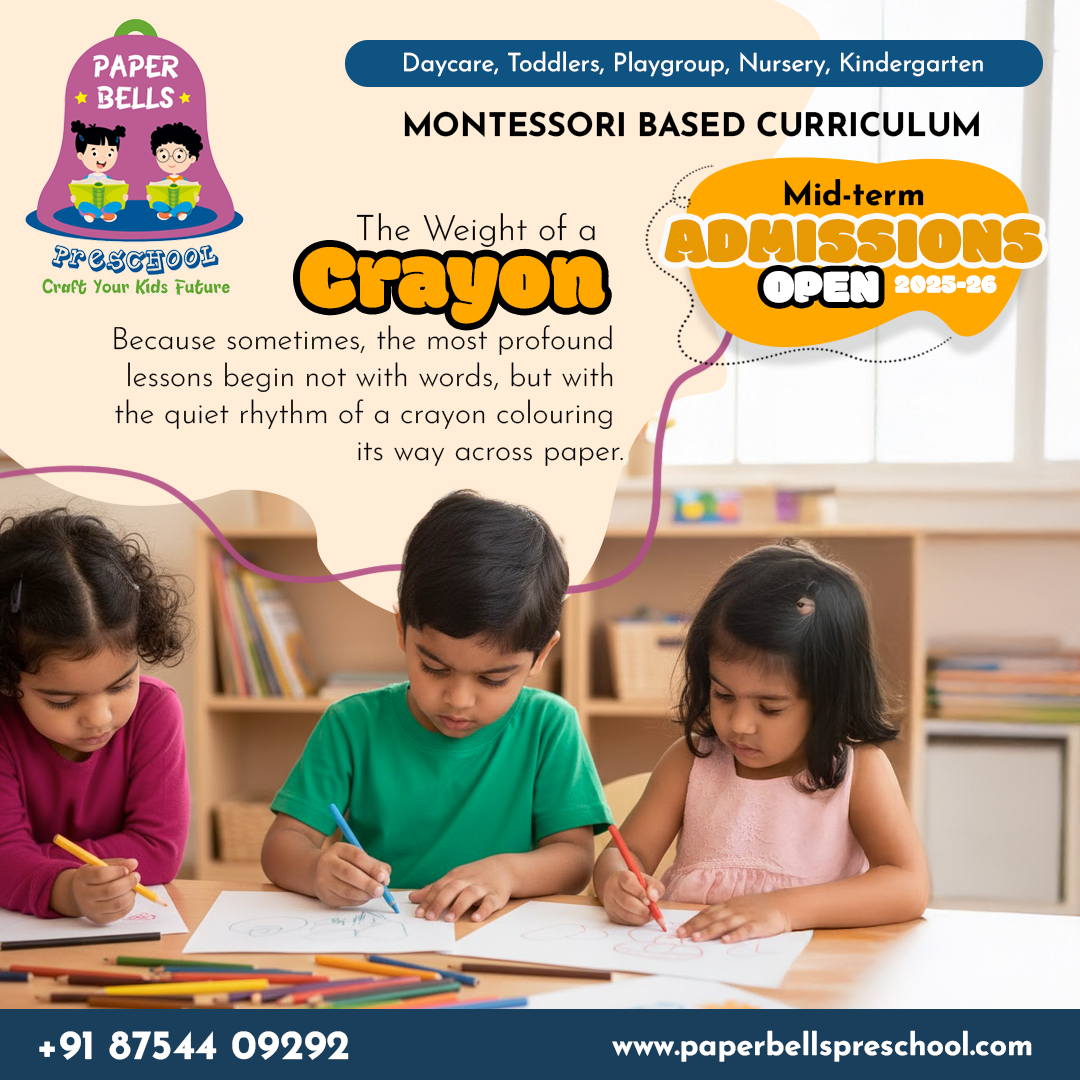
Because sometimes, the most profound lessons begin not with words, but with the quiet rhythm of a crayon colouring its way across paper.


