
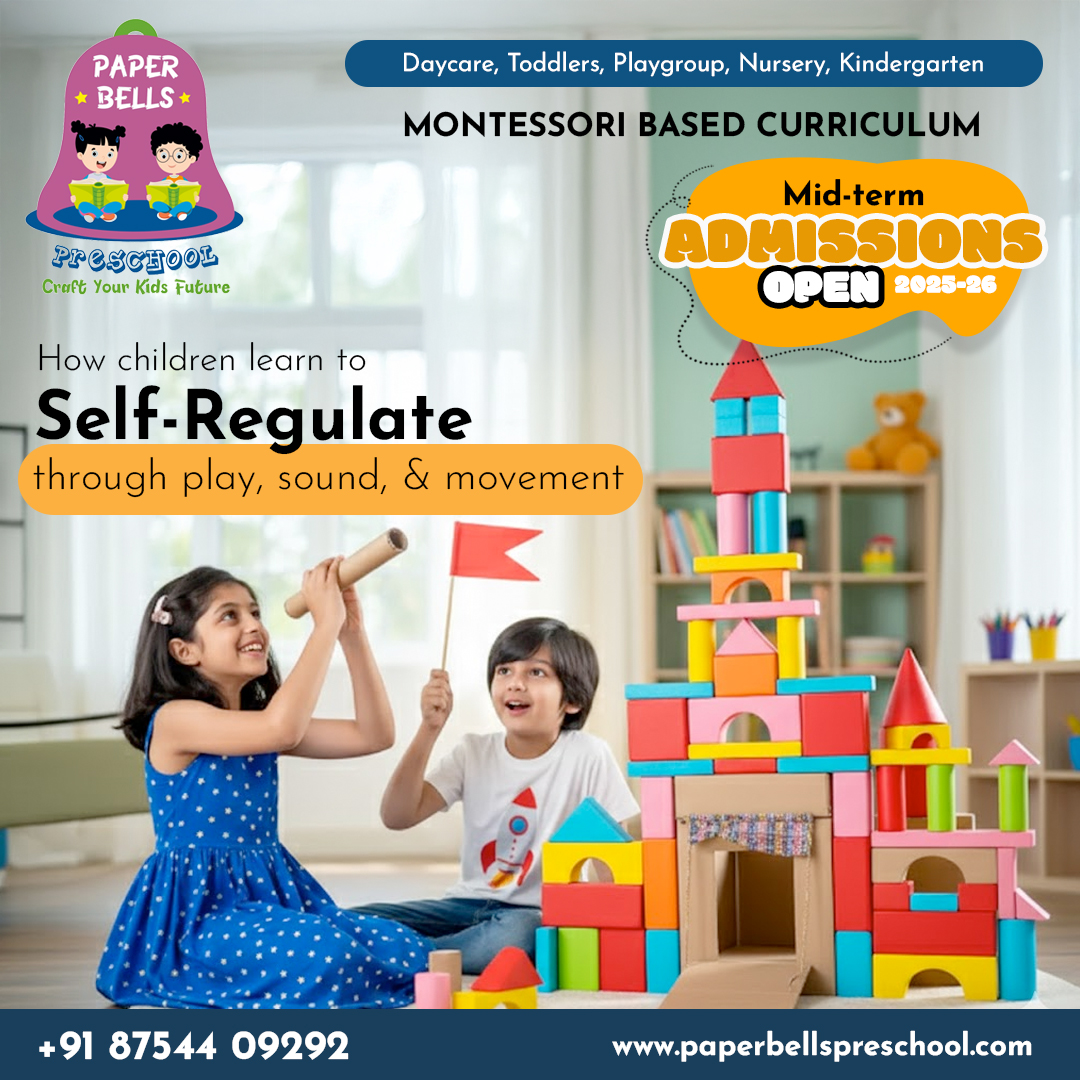
A reflection on how children learn to self-regulate through play, sound, and movement
If you've ever watched a preschooler move through their day, you'll notice an enchanting rhythm: moments of wild laughter followed by quiet focus, bursts of energy giving way to thoughtful stillness. It might look like chaos to adults - but to a child, this dance between activity and calm is how they learn to find balance within themselves.
At Paperbells Preschool, a premium preschool chain in Hebbal, we understand that emotional regulation doesn't come from control - it comes from experience. Children learn to find their balance not by being told to sit still, but by exploring, moving, and feeling. They discover calm through sound, rhythm, and play, not through restraint or silence.
In this blog, we explore how the early years become the foundation for self-regulation - and how Paperbells helps children navigate their beautiful chaos with gentleness, awareness, and joy.
The Beauty of Chaos in Early Childhood
Childhood is a flurry of discovery. Children are naturally impulsive, curious, and expressive. One moment they're giggling uncontrollably; the next, they're teary-eyed because a block tower fell. To adults, these emotional swings may seem erratic - but they are actually the brain's way of learning how to balance.
At Paperbells Preschool, we see this "chaos" not as a challenge to manage, but as a natural part of growth. It's through the freedom to express big feelings that children begin to understand them. Every laugh, stomp, shout, or sigh is an experiment in self-awareness.
We don't ask children to suppress their energy; we help them channel it. Because true calm doesn't come from silence - it comes from emotional safety.
Understanding Self-Regulation: The Art of Inner Balance
Self-regulation is the ability to manage one's emotions, attention, and behaviour in response to the world around them. For young children, this is a developmental skill, not an instant expectation. It's built slowly - through trust, repetition, and nurturing environments.
At Paperbells Preschool in Hebbal, teachers gently guide children through these early emotional lessons. When a child feels overwhelmed, we don't rush to "fix" the emotion; we help them name it, express it, and recover from it. This consistent modelling teaches children that feelings aren't permanent - they can be understood and managed.
Our classrooms are full of small but powerful moments of learning: a teacher showing how to take a deep breath, friends learning to wait for a turn, or a group of toddlers calming after a lively dance session. Every one of these moments strengthens their ability to self-regulate.
Play: The Most Powerful Path to Regulation
Play is more than joy - it's a child's way of making sense of the world. When children play, they are not just having fun; they are negotiating boundaries, testing limits, and learning patience.
In the vibrant environment of Paperbells Preschool, Hebbal, play becomes the most natural setting for emotional growth. Whether it's stacking blocks, role-playing, or building in the sandpit, each activity helps children learn to control impulses, share space, and recover from frustration.
Consider a simple moment: a child working hard to fit a puzzle piece that doesn't align. At first, there's eagerness, then confusion, maybe frustration. But with gentle encouragement and space to try again, the child learns persistence and calm focus. That is regulation in its most organic form - born not from instruction, but from experience.
The Language of Sound and Movement
Children often process emotions not through words but through sound and movement. They hum, clap, jump, run, spin - they express what they feel with their bodies long before they can articulate it.
At Paperbells, we embrace this natural form of communication. Music, rhythm, and movement are woven into our daily routine because they create a bridge between emotion and understanding.
Dancing to soft tunes helps release energy. Gentle music during transitions signals rest. Rhythmic clapping or drumming creates focus and synchrony. These sensory-rich experiences teach children how to shift their emotional states - how to move from excitement to calm, from noise to stillness, with ease and joy.
Through this, they begin to understand a profound truth: calm is not the absence of sound - it's harmony between the inner and outer world.
Why Emotional Safety Comes Before Calm
Before children can self-regulate, they must feel safe. Emotional safety isn't about having no conflict or noise; it's about knowing they are accepted even when they make mistakes.
At Paperbells Preschool, emotional safety is built through strong, trusting relationships. Teachers listen, validate, and comfort without judgment. When a child cries, they are not told to "stop crying" - they are comforted. When a child is upset, they are guided toward understanding, not reprimanded for reacting.
This kind of consistent empathy becomes the emotional anchor that allows self-regulation to develop naturally. A child who feels safe learns to pause and breathe, not out of fear, but out of understanding.
Movement and Mindfulness: The Everyday Balance
One of the beautiful things about early childhood is how naturally mindfulness can be nurtured through everyday activities. At Paperbells Preschool, movement isn't just about exercise - it's about awareness.
Children are encouraged to notice their bodies, their breathing, and their surroundings. In yoga-inspired stretches, they learn to feel stillness. In outdoor play, they experience rhythm and flow. In creative movement sessions, they explore how emotion feels when expressed through their limbs.
These are not just fun activities - they are subtle, mindful practices helping children build a lifelong relationship with balance. Over time, this rhythm between movement and stillness becomes instinctive.
The Role of Teachers: Gentle Guides of Emotion
Teachers at Paperbells are not just educators; they are emotional guides. They understand that a child's meltdown is not misbehaviour - it's communication.
When a child's emotions overflow, our teachers approach with calmness rather than correction. They kneel down, make eye contact, and help the child navigate the storm: "I see you're upset. Let's take a breath together."
These small acts of compassion show children that emotions are not to be feared. They can be managed, soothed, and understood. Through repeated, empathetic guidance, children internalise this calm - eventually learning to self-soothe without adult intervention.
This emotional mentoring forms the backbone of the Paperbells Preschool philosophy in Hebbal - education that honours both the mind and the heart.
Creating Environments That Support Balance
Every inch of a Paperbells classroom is designed with intention. Spaces are colourful but not overstimulating, lively yet grounded. There are quiet corners for rest, open areas for movement, and materials that engage all the senses.
This physical environment teaches regulation in subtle ways. The presence of order in space invites order in emotion. The freedom to move fosters independence, while cozy corners offer comfort and retreat. It's in these contrasts that children find their own rhythm - learning when to move, when to rest, when to speak, and when to listen.
Parents as Partners in Balance
At Paperbells, we see parents as co-regulators. The way children are guided at home deeply affects their ability to manage emotions at school. That's why we partner with families - sharing insights, gentle strategies, and reminders that self-regulation takes time.
We remind parents that a child's big emotions are not a reflection of failure, but of development. That the loud, curious, sometimes chaotic child is not "too much" - they are learning how to navigate a complex world.
Together, school and home can create a consistent rhythm of calm - one where children are given the time, space, and safety to grow into emotionally intelligent individuals.
Finding Balance in a Fast World
In a world that constantly pushes speed, efficiency, and performance, children need spaces that let them be whole. Paperbells Preschool in Hebbal offers that space - a nurturing environment where chaos is welcomed, emotions are understood, and calm is gently cultivated.
We believe balance isn't taught - it's discovered. And when children discover that balance between movement and stillness, noise and quiet, joy and reflection - they discover themselves.
A Premium Preschool That Understands the Heart of Learning
As a premium preschool chain in Hebbal, Paperbells is built on the belief that education begins with emotional well-being. Academic milestones are important, but it is emotional balance that makes learning meaningful.
Every teacher, every classroom, every activity is designed to help children grow not just smarter, but steadier - to help them navigate the beautiful dance between chaos and calm with confidence and grace.
Because at Paperbells, we know that the goal isn't to silence the chaos. It's to help every child find their own music within it.
The Harmony of Growth
Childhood will always have its whirlwind moments - tears, laughter, noise, and quiet - but within that mix lies the essence of growth. The child who runs, sings, and plays today is also learning to pause, listen, and breathe tomorrow.
At Paperbells Preschool, Hebbal, we celebrate this rhythm of becoming. Between chaos and calm, we see a world of wonder - a place where balance is not demanded, but discovered, joyfully and naturally, every single day.


