
The Unspoken World of Early Communication
At first glance, preschoolers may seem like a whirlwind of movement, laughter, and curiosity, yet beneath their playful energy lies a sophisticated world of non-verbal communication. A glance across the room, a reassuring smile, a gentle nod-these tiny gestures carry enormous meaning. At Paperbells Preschool, Hebbal, one of the best preschool chains in Hebbal, we recognize the power of non-verbal cues as a window into early emotional intelligence, social understanding, and self-expression.
Long before children can articulate complex thoughts or narrate experiences in full sentences, they communicate, understand, and connect through gestures, expressions, and body language. A well-timed smile can calm a hesitant peer, a curious look can signal readiness to engage, and a shared giggle can establish bonds of friendship. These seemingly small actions are the foundation of communication skills that will serve children throughout life.
Non-Verbal Communication as a Building Block
Non-verbal communication is not merely a substitute for words; it is a rich and dynamic language in itself. At Paperbells Preschool, Hebbal, we create environments that encourage children to notice, interpret, and respond to these cues. From collaborative play in our activity zones to interactive storytelling sessions, every experience offers opportunities to practice recognizing subtle social signals.
When a child watches a friend's face light up with excitement, they learn empathy-the ability to understand and share another's feelings. When a teacher offers a reassuring smile or nod during a challenging activity, children gain confidence and a sense of safety. Over time, these micro-interactions strengthen emotional intelligence, laying the groundwork for effective communication, cooperation, and leadership.
The Role of Play in Emotional Understanding
Play is the natural arena in which non-verbal communication flourishes. Blocks are built, sandcastles are molded, and games are imagined, all while children navigate the unspoken rules of interaction. At Paperbells, we observe how gestures guide play: a hand held out to invite a peer, a furrowed brow signaling frustration, or a joyful clap of hands marking shared success. Each interaction is a learning opportunity, teaching children to read the emotions of others, respond appropriately, and express themselves without relying solely on words.
The beauty of these moments lies in their authenticity. Children are naturally attuned to facial expressions, body language, and tone, absorbing these cues as they experiment with their own gestures. By observing and participating in these interactions, they develop a nuanced understanding of social dynamics, paving the way for strong interpersonal skills.
Teachers as Guides in Non-Verbal Communication
The bond between teachers and children is central to the development of non-verbal communication skills. Educators at Paperbells Preschool do more than supervise-they model gestures, expressions, and empathetic responses that children can emulate. A comforting look when a child struggles with a task, a nod of encouragement during a group activity, or an animated expression during storytelling not only conveys meaning but also teaches children how to convey their own emotions effectively.
By providing consistent examples of non-verbal cues, teachers help children interpret social situations with confidence. They offer reassurance without words, celebrate accomplishments through smiles and gestures, and gently guide children toward constructive interaction with peers. These subtle, repeated experiences cultivate a rich understanding of emotional language, preparing children for the complex social landscapes they will encounter in school and beyond.
Non-Verbal Communication and Peer Learning
Peer interaction amplifies the lessons of non-verbal communication. Children learn as much from observing their friends as from participating in structured activities. A peer's excited gesture can inspire creativity, a worried look can prompt comforting behavior, and a shared laugh can reinforce positive social bonds. At Paperbells, collaborative play and group activities are designed to maximize these micro-interactions, allowing children to decode emotions, develop empathy, and practice expressive gestures in safe and supportive settings.
These moments also reinforce the concept of reciprocity in communication. Children learn that gestures have meaning not only for themselves but also for others-that a smile can uplift, a gesture can guide, and an expression can communicate more than words alone. This understanding of relational dynamics is a cornerstone of emotional intelligence, contributing to confidence, cooperation, and social competence.
The Intersection of Emotional Intelligence and Cognitive Growth
Non-verbal communication does more than build social skills; it intersects with cognitive development as well. Recognizing and responding to gestures requires attention, memory, and interpretation-complex processes that stimulate brain growth. At Paperbells, we see children develop critical thinking and problem-solving abilities as they navigate social interactions, decode emotional cues, and make decisions based on observations of peers and teachers.
For example, during a collaborative art project, children may notice a peer struggling with a task and respond with a helping hand or an encouraging gesture. In doing so, they integrate empathy with action, observation with judgment, and intention with execution. These "tiny gestures" are, in essence, exercises in emotional reasoning, laying a foundation for effective communication, leadership, and interpersonal skills.
Celebrating the Subtle Wins
At Paperbells Preschool, Hebbal, we celebrate the subtle, often overlooked triumphs of non-verbal communication. A shy child learning to make eye contact, a peer offering a comforting touch, or a group successfully coordinating a game through gestures alone-all are moments that reflect emotional growth, social understanding, and developing self-confidence. By nurturing these moments daily, we ensure that children gain not only academic skills but also the emotional literacy necessary for lifelong success.
The recognition of these small but significant achievements fosters self-esteem and encourages further exploration. When children notice that their gestures have an impact on others, they gain a sense of agency and responsibility, learning that communication is a two-way process of giving and receiving understanding.
The Long-Term Impact of Early Non-Verbal Communication
Children who master non-verbal communication early are better equipped to navigate complex social environments as they grow. They develop empathy, adaptability, and confidence, skills that complement academic learning and contribute to well-rounded development. At Paperbells, our commitment to nurturing these skills ensures that students leave preschool with a strong foundation in emotional intelligence, ready to engage with the wider world with awareness and sensitivity.
Creating a Culture of Awareness and Connection
The emphasis on non-verbal communication reflects Paperbells Preschool's broader philosophy: that education is as much about emotional and social growth as it is about academics. By fostering attentive observation, empathetic interaction, and expressive gestures, we cultivate an environment in which children feel understood, valued, and connected. The relationships they form-with peers, teachers, and the learning environment itself-become the medium through which self-awareness and interpersonal skills are strengthened.
Learning Beyond Words
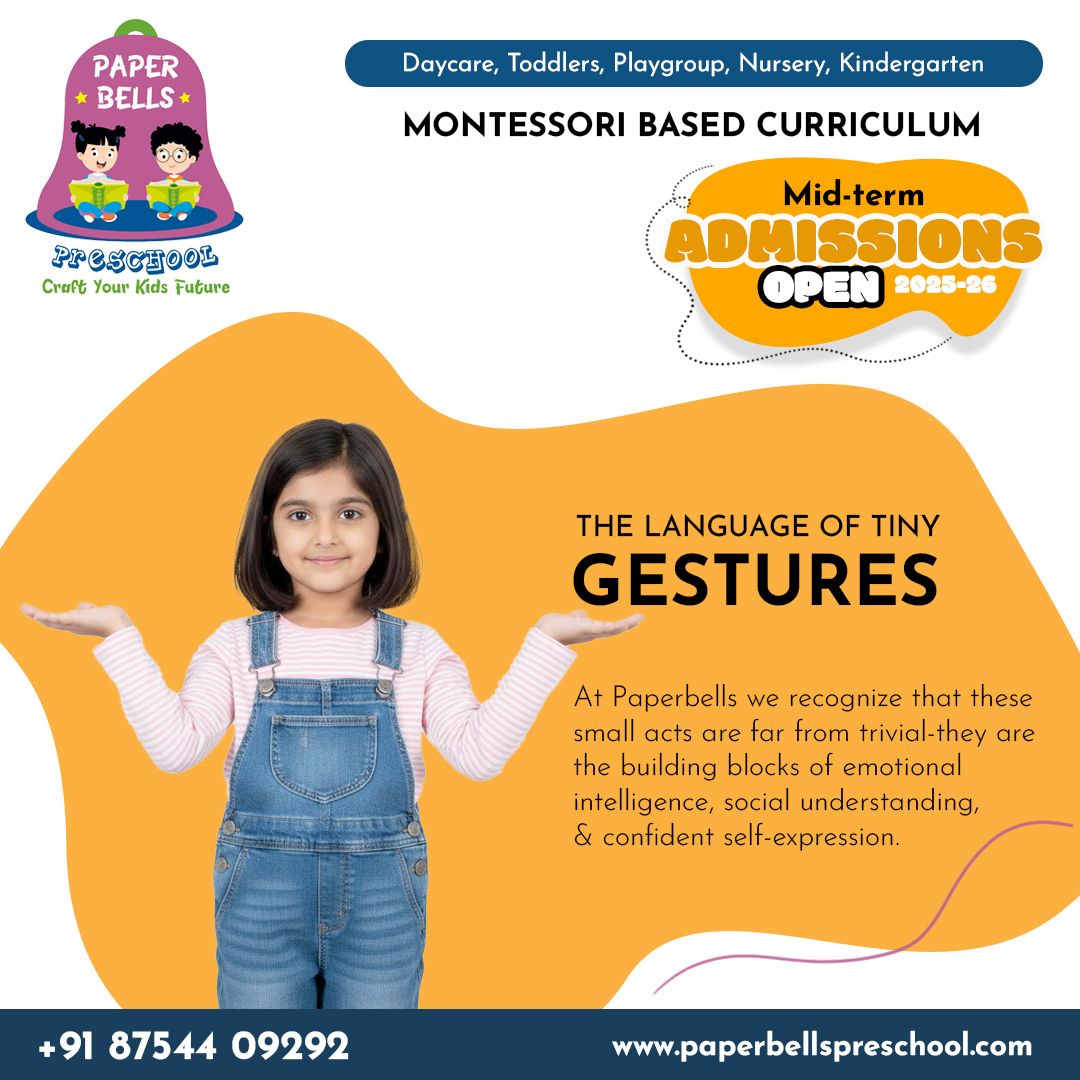
In the bustling, imaginative world of preschool, much of the most important learning happens quietly, in gestures, glances, and shared smiles. At Paperbells Preschool, Hebbal, one of the best preschool chains in Hebbal, we recognize that these small acts are far from trivial-they are the building blocks of emotional intelligence, social understanding, and confident self-expression.
By providing a supportive environment, modeling empathetic communication, and creating opportunities for meaningful peer interaction, we ensure that children develop a rich "language of gestures" alongside their verbal skills. Through this process, they learn to understand themselves, connect with others, and navigate the world with awareness and compassion.
Ultimately, when a child learns to communicate with a look, a smile, or a subtle gesture, they are discovering the profound power of connection-an essential skill that will support them throughout life. At Paperbells Preschool, these tiny, meaningful moments are celebrated every day, forming the foundation of confident, empathetic, and socially intelligent learners.


