
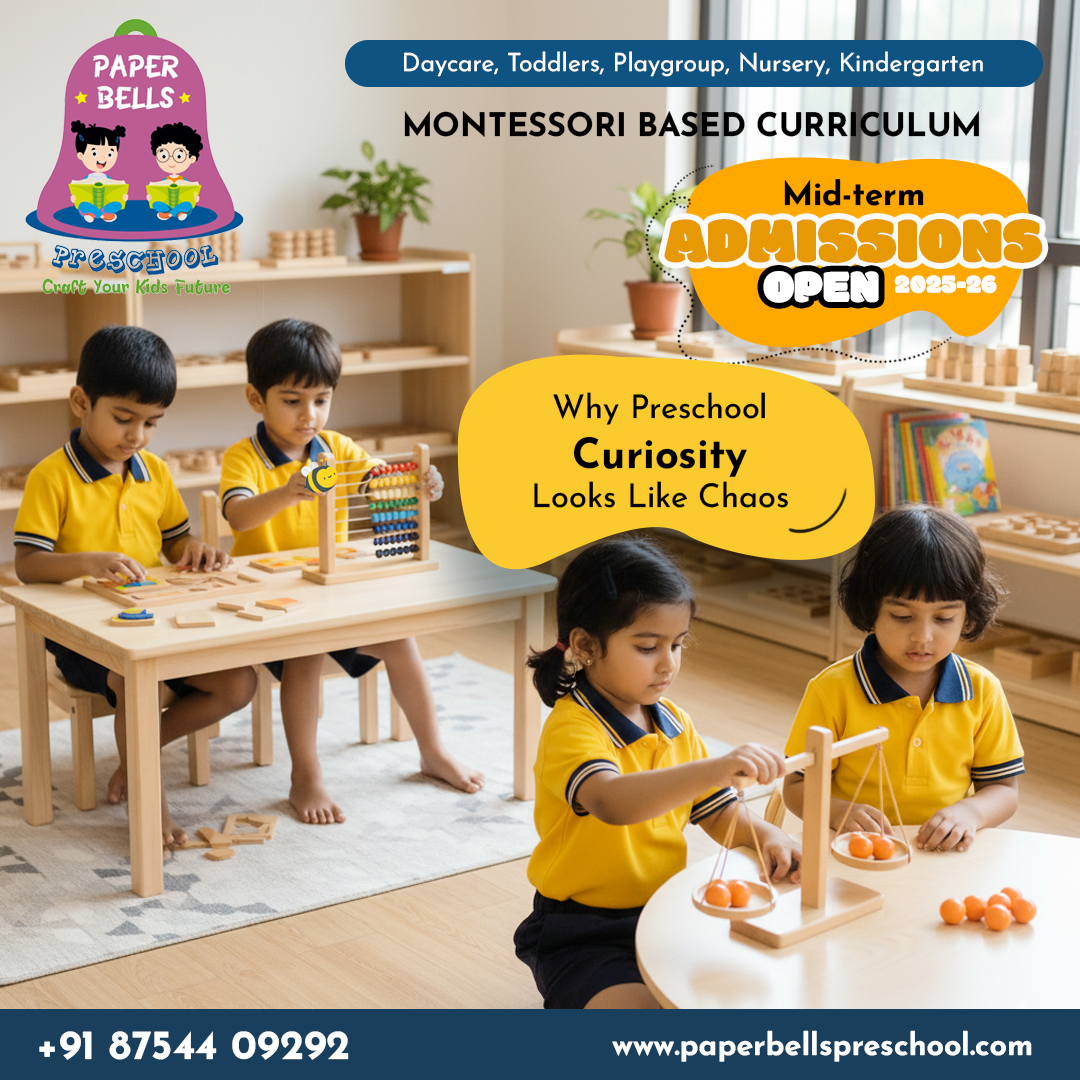
The Beauty Behind the Mess
Walk into a preschool classroom on any given morning and you might be greeted by a whirlwind of activity. Children darting between play corners, paintbrushes splashing with bright colors, blocks tumbling to the floor, giggles mingling with a chorus of "why?" questions-it may appear like beautiful chaos. For parents, especially those who associate learning with orderly desks and quiet concentration, the energy of a preschool classroom can feel overwhelming. Yet, what looks like a disorder to the untrained eye is, in fact, one of the most powerful engines of early learning: curiosity.
At Paperbells Preschool in Hebbal, recognized as one of the best preschools in Hebbal, we embrace this apparent chaos as a sign of thriving curiosity. Rather than suppressing it, we channel it, knowing that curiosity is not a distraction from learning-it is the very foundation of it.
Why Curiosity Looks So Chaotic
Curiosity, by its very nature, is exploratory. Children are not yet bound by rigid expectations of how to approach a problem or activity. Instead, they engage with the world as scientists do-through trial, error, experimentation, and discovery. That means they will pour water on sand just to see what happens, mix every paint color together to observe the outcome, or ask the same question in five slightly different ways.
This instinctive need to explore can create what looks like disorder: toys scattered across the floor, multiple unfinished drawings, children moving from one corner of the room to another with little pause. But each seemingly chaotic action is evidence of neural connections forming, theories being tested, and early problem-solving skills developing. At Paperbells Preschool in Hebbal, our teachers are trained to recognize that behind the paint-smeared aprons and toppled towers lies the brilliance of a child's curiosity at work.
Chaos as a Classroom Tool
What sets Paperbells Preschool apart is not just accepting the mess, but transforming it into a structured developmental opportunity. While children may be scattered across activities, the environment is carefully designed to encourage meaningful exploration. Play corners are thoughtfully arranged to spark engagement-blocks in one space, art in another, music and movement nearby-each inviting children to dive deep into a different dimension of learning.
The "chaos" here is not random; it is orchestrated. Educators observe, guide, and extend children's natural curiosity, ensuring that what begins as scattered exploration leads to tangible skills in language, problem-solving, creativity, and collaboration. The classroom hums with energy, but beneath it all lies intention, structure, and purpose.
Why Curiosity Is the Engine of Learning
Curiosity fuels motivation. When children are genuinely interested in something, they persist longer, explore deeper, and remember better. This is why, at Paperbells Preschool in Hebbal, we do not equate a "quiet classroom" with a "productive classroom." A classroom alive with questions, movement, and experimentation is where learning thrives.
Think of a child repeatedly rolling cars down a slope. To an adult, this may look like monotonous play. But in reality, the child is testing hypotheses about speed, force, and gravity. Another child might insist on mixing colors again and again, not because they forgot yesterday's outcome, but because they are searching for patterns and surprises. Curiosity invites them back, encouraging resilience and persistence-the very qualities that will later power academic learning.
From Chaos to Confidence
Allowing curiosity to lead does more than build knowledge; it builds confidence. When children explore freely, they learn to trust their instincts, take risks, and recover from mistakes. The messy paint splatters and collapsed block towers are not failures-they are attempts, and each attempt strengthens both skill and self-assurance.
At Paperbells Preschool in Hebbal, one of the best preschools in the area, children are encouraged to celebrate the process, not just the outcome. This approach transforms the classroom into a safe space for trial and error, where children understand that curiosity often looks imperfect, but that imperfection is exactly where growth lives.
The Role of Teachers in Harnessing Curiosity
Curiosity-driven classrooms require thoughtful facilitation. Teachers at Paperbells Preschool are not passive observers of chaos; they are skilled guides who shape it. They step in with questions that extend thinking: "What do you think will happen if we add more blocks to the tower?" or "What would happen if we used less water in the sand?" These questions do not shut down curiosity-they direct it, giving children the tools to dig deeper without stifling their instinct to explore.
This subtle scaffolding transforms moments of chaos into pathways of discovery. Teachers provide gentle nudges toward new connections while leaving space for children to lead their own learning journeys.
The Emotional Value of Messy Learning
The "chaos" of curiosity is also emotionally rich. It is in these moments of unstructured exploration that children experience joy, freedom, and ownership of their learning. The delight of discovery-whether it's watching a paper boat float across water or hearing a new sound made by banging two objects together-becomes a powerful motivator.
At Paperbells Preschool in Hebbal, classrooms are not just places of academic growth, but of emotional safety. Children know they can be messy, noisy, and exploratory without judgment. This freedom builds resilience, adaptability, and a love for learning that extends well beyond preschool years.
Reframing Chaos for Parents
For many parents, it can be reassuring to understand that what looks like disorder is, in fact, learning in action. At Paperbells, we invite families to see beyond the scattered toys and hear beyond the noise. Every overturned block, every spilled cup of water, and every burst of laughter is part of a structured developmental journey.
By reframing curiosity-driven chaos as intentional, parents can begin to appreciate the extraordinary progress hidden within the ordinary mess. It is not a sign of a lack of discipline, but of an environment where learning is alive and thriving.
Why Paperbells Preschool in Hebbal Stands Out
As one of the best preschools in Hebbal, Paperbells has crafted a philosophy that balances freedom and structure. We understand that curiosity does not thrive in silence or rigid instruction. Instead, we create classrooms that honor children's natural instincts while offering the thoughtful guidance needed to shape them into meaningful growth.
Our spaces are designed to be dynamic-full of colors, textures, and opportunities for exploration-while our educators are trained to harness curiosity without stifling it. This balance ensures that children experience both the joy of discovery and the benefits of structured learning.
Families in Hebbal searching for a preschool that values curiosity as much as competence, exploration as much as instruction, and joy as much as achievement will find Paperbells Preschool to be a natural choice.
The Long-Term Payoff of Curiosity
The messy energy of preschool curiosity does not end in early childhood. It plants the seeds for lifelong learning. Children who are encouraged to ask questions, test their ideas, and embrace exploration become adults who are innovative, resilient, and adaptable.
At Paperbells Preschool in Hebbal, we see curiosity not as a stage to be managed, but as a strength to be nurtured. The "chaos" of today's classrooms builds the thinkers, problem-solvers, and creators of tomorrow.
Celebrating the Beautiful Chaos
Curiosity may look like chaos, but in the hands of skilled educators and within the nurturing environment of Paperbells Preschool, it becomes the heartbeat of learning. Every splash of paint, every tumble of blocks, every chorus of questions is evidence of a child's mind reaching out, testing, and growing.
In Hebbal, where families seek one of the best preschools to provide both academic foundations and emotional growth, Paperbells offers a place where curiosity is not only welcomed but celebrated.
Our classrooms prove that what looks like disorder is, in fact, the purest form of order: children making sense of their world in the way they were born to-through curiosity, exploration, and joyful discovery.


