
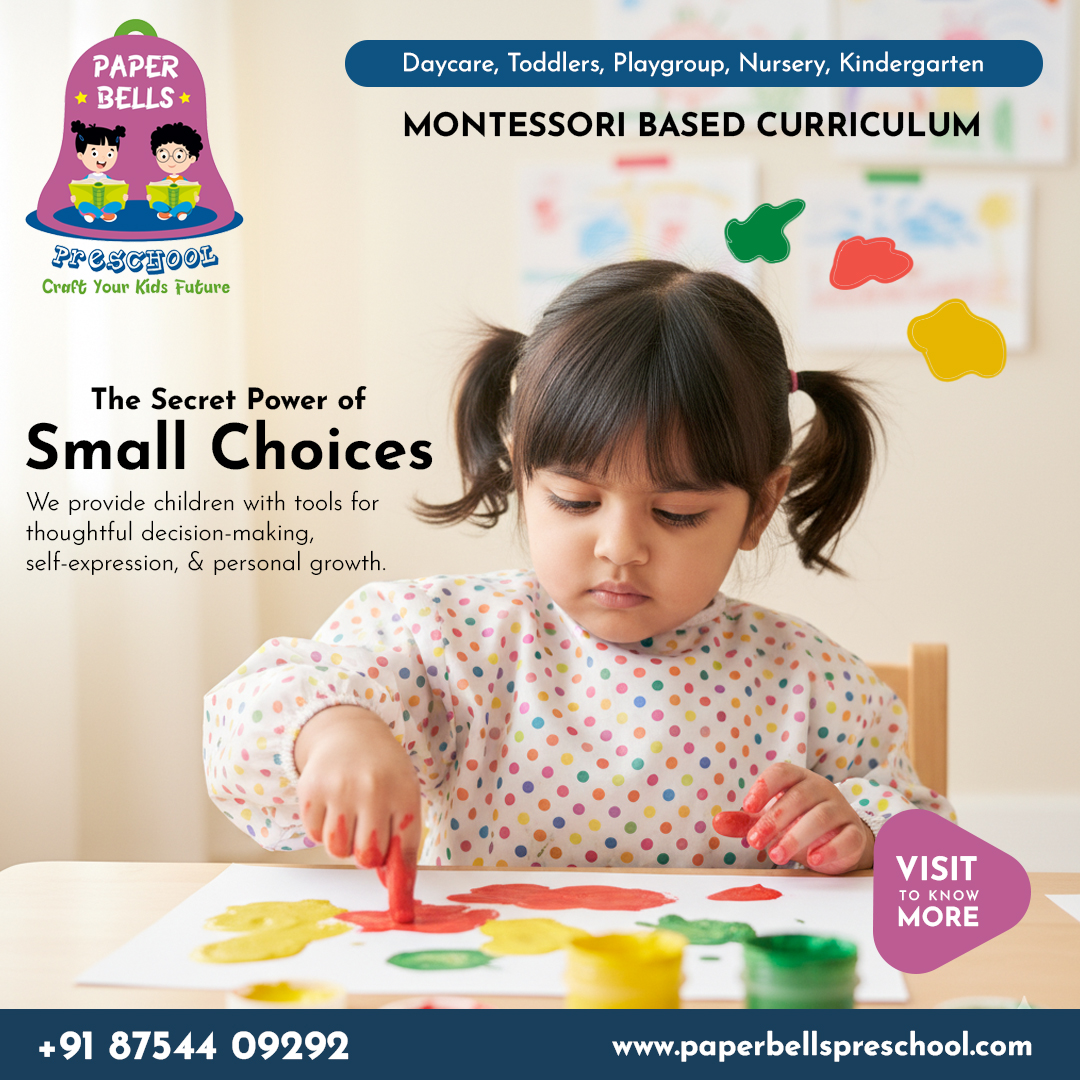
Small Decisions, Big Impact
At first glance, the act of choosing a crayon color, selecting a seat for storytime, or deciding which activity to try may appear trivial in the bustling world of preschool. Yet, at Paperbells Preschool, Hebbal, one of the best preschool chains in Hebbal, we understand that these seemingly small choices are pivotal in nurturing independence, self-confidence, and decision-making skills. Each day, children navigate a landscape of options that allow them to discover their preferences, test their judgment, and build autonomy-the foundational elements of lifelong learning.
Early childhood is a critical stage for developing the ability to make decisions. When children are encouraged to make small choices, they learn to consider possibilities, anticipate outcomes, and reflect on their own desires and needs. Over time, these daily experiences cultivate not only independence but also a sense of ownership over their learning journey, fostering confidence and resilience in ways that formal instruction alone cannot achieve.
Choice as a Pathway to Independence
The ability to make choices empowers children to take control of their environment, even in small ways. At Paperbells Preschool, Hebbal, our classrooms are thoughtfully designed to present opportunities for decision-making. From selecting materials for creative projects to determining the sequence of activities during play, children are consistently invited to participate in choices that affect their day.
This approach nurtures a sense of agency. When a child confidently chooses a paintbrush, a play corner, or a partner for a cooperative task, they are learning to trust their own judgment. Such moments, repeated daily, accumulate into a strong foundation of self-reliance. Independence, in this context, is not simply about doing tasks alone-it is about cultivating the confidence to make decisions, to assert preferences, and to navigate social and educational environments with purpose.
Learning Through Exploration
Choices also encourage exploration and curiosity. When a child decides to explore a new activity-whether it's building a tower with blocks, experimenting with water play, or joining a music circle-they are exercising their capacity to evaluate options and embrace new experiences. At Paperbells, our educators create an environment where the spectrum of choices is rich yet manageable, allowing children to experience success, experimentation, and, sometimes, constructive failure.
Each decision, whether big or small, becomes a lesson in evaluating possibilities and understanding consequences. When children select a crayon color and discover a preference for blue over red, or when they choose a puzzle that challenges their skills, they are learning about cause and effect, personal taste, and problem-solving. These seemingly simple acts form the scaffolding for complex decision-making abilities later in life.
Teachers as Guides in Choice-Making
The role of teachers is central in nurturing decision-making skills. At Paperbells Preschool, Hebbal, educators act as facilitators, guiding children in considering options without dictating outcomes. A teacher might present two equally appealing materials for a project, encourage a child to choose, and then provide gentle reflection afterward: "What made you pick this one today?" Such interactions help children articulate their thinking, recognize their preferences, and develop self-awareness alongside independence.
Teachers also model decision-making through their own choices and interactions, demonstrating that making decisions is a natural and positive part of everyday life. By observing thoughtful consideration, flexibility, and problem-solving in their educators, children learn that choices are both empowering and manageable.
Building Confidence Through Daily Decisions
Confidence and self-esteem flourish when children are trusted to make choices. Each decision, from the trivial to the slightly more complex, reinforces the child's sense of capability. A preschooler choosing a storybook, a friend for cooperative play, or a snack option experiences tangible evidence that their opinions matter and that they can navigate their environment independently.
At Paperbells, we celebrate these small victories. The glow of pride when a child selects an activity and follows it through, or when they navigate a social choice among peers, is an affirmation of their emerging autonomy. Such experiences are not merely about preference-they are about developing the internal compass that guides thoughtful, confident, and independent action.
Social Skills Through Shared Choices
Decision-making is also deeply social. In group settings, children negotiate, collaborate, and compromise. Choosing a game to play, dividing roles in a creative project, or determining the order of turns in an activity teaches children to weigh the needs and desires of others alongside their own. This process cultivates empathy, communication skills, and cooperation-critical components of emotional intelligence.
At Paperbells, our educators scaffold these interactions with sensitivity, helping children navigate disagreements and recognize the value of shared decision-making. Children learn not only to assert themselves but also to listen, adapt, and consider the perspectives of peers. These skills are transferable across every domain of life, forming a cornerstone of healthy social development.
Cognitive Growth Through Everyday Choices
The process of making decisions engages multiple cognitive skills simultaneously. Children must observe their environment, assess options, anticipate potential outcomes, and recall past experiences. By integrating these cognitive processes with real-world actions, children are strengthening their executive function, problem-solving skills, and critical thinking-all while engaging in play that feels natural and enjoyable.
For example, when a child chooses between two activity stations, they evaluate interest, skill level, and social dynamics. When they select materials for a creative project, they consider color, texture, and purpose. Each of these acts involves observation, memory, reasoning, and judgment-a sophisticated cognitive workout wrapped in the joy of play.
The Role of Environment in Choice
A thoughtfully designed environment amplifies the power of choice. At Paperbells Preschool, Hebbal, classrooms are organized to offer multiple avenues for exploration while maintaining a balance that prevents overwhelm. Materials are accessible, options are visible, and the flow of activities is intuitive. This careful structuring ensures that children can make meaningful choices that are safe, engaging, and developmentally appropriate.
By providing a variety of options within a supportive framework, we allow children to experiment with independence, make mistakes, learn, and celebrate successes. The environment itself becomes a teacher, inviting curiosity and promoting active decision-making.
Fostering a Lifelong Love of Learning
Encouraging children to make small choices nurtures more than independence-it fosters intrinsic motivation. When children feel that their decisions matter, they are more likely to engage fully, persist through challenges, and explore new possibilities with enthusiasm. The confidence gained from these experiences spills over into all areas of learning, creating a cycle of curiosity, exploration, and self-assurance.
At Paperbells Preschool, Hebbal, our mission is to cultivate independent, confident learners who are excited to engage with the world. By honoring the power of small choices every day, we provide children with tools for thoughtful decision-making, self-expression, and personal growth.
Small Choices, Big Futures
In the daily rhythm of preschool life, the seemingly minor decisions-selecting a crayon, a chair, or an activity-carry transformative power. Each choice reinforces independence, builds confidence, and strengthens decision-making skills. At Paperbells Preschool, Hebbal, one of the best preschool chains in Hebbal, we recognize that supporting children in making these choices is not just about fostering autonomy-it is about preparing them for a future where self-confidence, critical thinking, and emotional intelligence are essential.
The next time a child chooses a color for their painting or decides which corner to explore, know that this simple act is a stepping stone toward independence, self-expression, and lifelong learning. Every small choice matters, and at Paperbells, we celebrate each one as a milestone in the journey of growth, curiosity, and discovery.


