
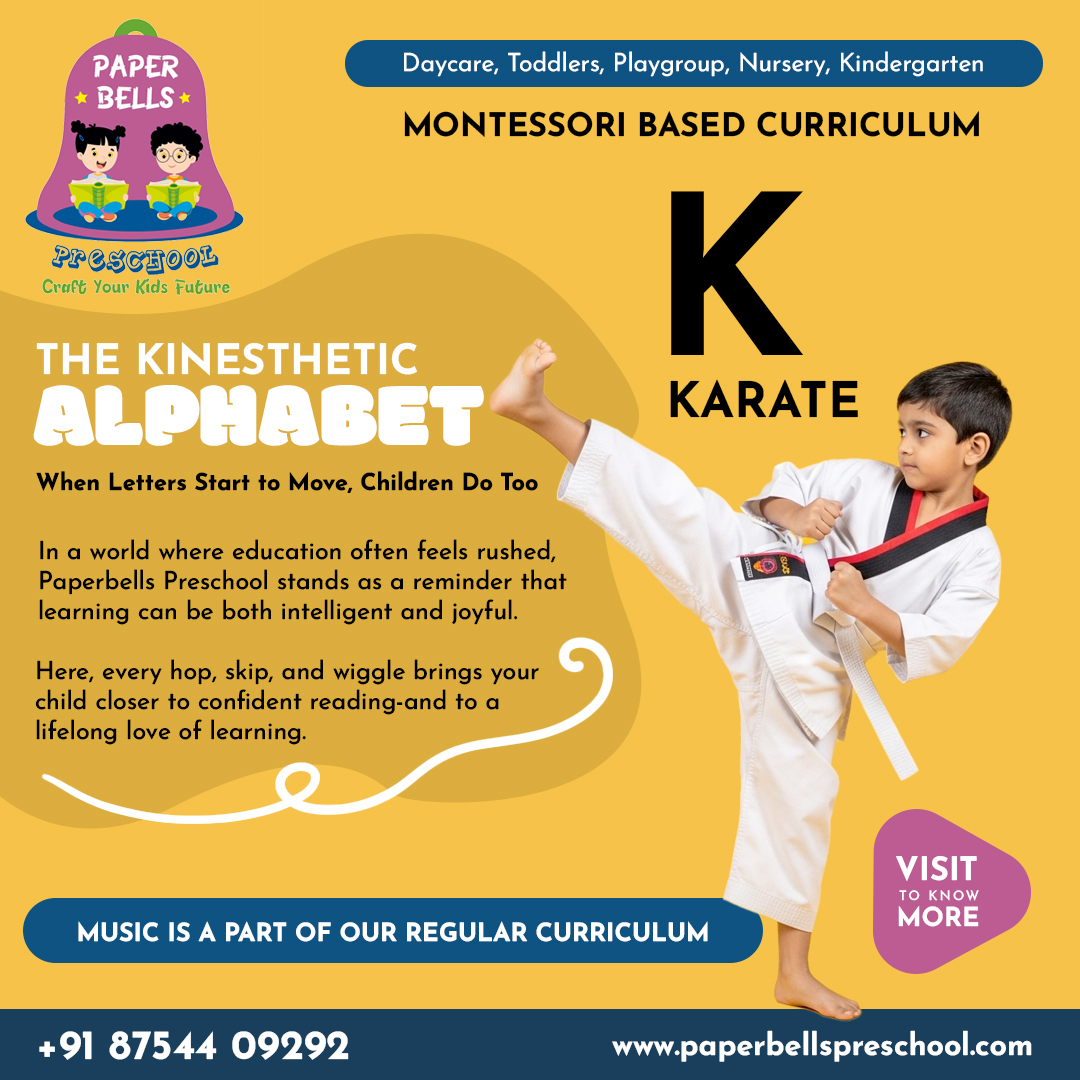
When Letters Start to Move, Children Do Too
For generations, learning the alphabet has meant sitting at a desk, tracing letters, and repeating sounds. But what if letters didn't just sit on a page? What if they leapt, twirled, and spun-inviting children to do the same? At Paperbells Preschool in Hebbal, we've discovered that when children learn letters through movement, something magical happens: they don't just memorize them-they embody them.
This approach, called the Kinesthetic Alphabet, combines literacy with rhythm, dance, and play. Instead of telling children, "A says 'ah'," we help them become the letter A by stretching arms wide like a mountain peak or spinning in a triangle shape. It's joyful, dynamic, and astonishingly effective. And while it may look like fun (and it is), there's serious developmental science behind this method.
Why Movement Unlocks Learning
Children are naturally wired to move. They explore the world by running, skipping, climbing, and dancing long before they can hold a pencil. Traditional early literacy often overlooks this, expecting very young learners to sit still before they are developmentally ready. The Kinesthetic Alphabet flips that expectation, making movement a bridge to memory and meaning.
When a child jumps to form a J or bends like a lowercase b, several things happen at once:
- Their brain processes letters through multiple senses-sight, sound, and physical sensation.
- Muscle memory reinforces recognition-they don't just see a letter, they feel it.
- Engagement skyrockets-instead of being passive learners, children are active participants, eager for the next shape, the next rhythm, the next dance.
This blend of cognitive and physical activity sparks connections in the brain that static worksheets simply can't replicate. And the best part? Children barely realize they're "studying." They're too busy laughing, spinning, and proudly announcing, "I am an S!"
Literacy That Feels Like Playtime
At Paperbells Preschool, known among the best CBSE schools in Hebbal, we believe that learning shouldn't feel like a chore-especially in the early years. The Kinesthetic Alphabet turns literacy lessons into a kind of movement theater. Imagine walking into a classroom and seeing children:
- swaying like tall T's,
- curling into cozy C's,
- zipping around like zigzagging Z's.
It looks like a game. In reality, it's a sophisticated, child-centered way of anchoring letter recognition and phonics in their developing brains. Because the experience is joyful, children approach letters with confidence instead of hesitation. That positive attitude carries forward into reading, spelling, and writing as they grow.
A Classroom Full of Dancing Letters
The scenes are as delightful as they are instructive. A group of children might form a human train to trace out the letter L on the playground, or clap to the beat of M as they march in sync. Teachers guide, but they also join in-because when adults dance through the alphabet too, it reinforces the idea that learning is a shared adventure.
These sessions do more than teach literacy:
- They improve gross motor coordination.
- They build teamwork and social confidence as children create shapes together.
- They encourage creativity, letting children decide, "How would YOU make an H with your body?"
The result? Letters aren't abstract symbols to memorize. They're friends you've danced with. They're shapes you've stretched into and rhythms you've stamped into the floor.
Why Parents Rarely See This Approach Explained
Many parents are familiar with phonics or tracing books, but kinesthetic learning still feels like a secret-even though educators have long known that children retain information better when it's linked to physical activity. At Paperbells Preschool, we make this method visible, so families understand why their children come home bubbling over with excitement about "dancing letters."
We invite parents to observe, participate, or simply hear about their child's day over pickup conversations. It's heartwarming to see how quickly parents go from, "Why are they moving around so much?" to "Oh, now I see why she remembers every single letter without struggle!"
Rooted in Research, Designed for Childhood
This isn't just a whimsical idea-it's rooted in neuroscience. Studies show that movement stimulates areas of the brain connected to memory and language. When children pair a letter's sound with a physical gesture, retention skyrockets. And because these gestures are playful and varied, children stay engaged long after the novelty of flashcards wears off.
The Kinesthetic Alphabet also complements CBSE's emphasis on holistic, activity-based learning in early childhood. At Paperbells Preschool, we integrate it seamlessly with our curriculum, ensuring that children are prepared not only for reading but also for a lifetime of curious, active learning.
An Invitation to Experience It Yourself
The best way to understand the Kinesthetic Alphabet is to see it in action. At Paperbells Preschool in Hebbal, our classrooms don't just talk about letters-they move with them. You'll find children who can't wait to learn, teachers who bring energy into every lesson, and an atmosphere where early literacy feels more like an adventure than an assignment.
As one parent put it:
"My child used to mix up letters constantly. Now she remembers them because she feels them. It's like the alphabet lives in her body."
We couldn't say it better. At Paperbells, we're proud to offer a learning experience where creativity, science, and joy meet. And if you're looking for a CBSE preschool in Hebbal that values innovation without losing sight of childhood's natural rhythm, this is the place.
Dancing Today, Reading Tomorrow
The Kinesthetic Alphabet is more than just a teaching technique-it's a philosophy. It reminds us that children learn best when they're allowed to be children: active, imaginative, and full of life. By letting letters dance, we ensure that literacy sticks not because children are forced to memorize, but because they are delighted to remember.
In a world where education often feels rushed, Paperbells Preschool stands as a reminder that learning can be both intelligent and joyful. Here, every hop, skip, and wiggle brings your child closer to confident reading-and to a lifelong love of learning.


