
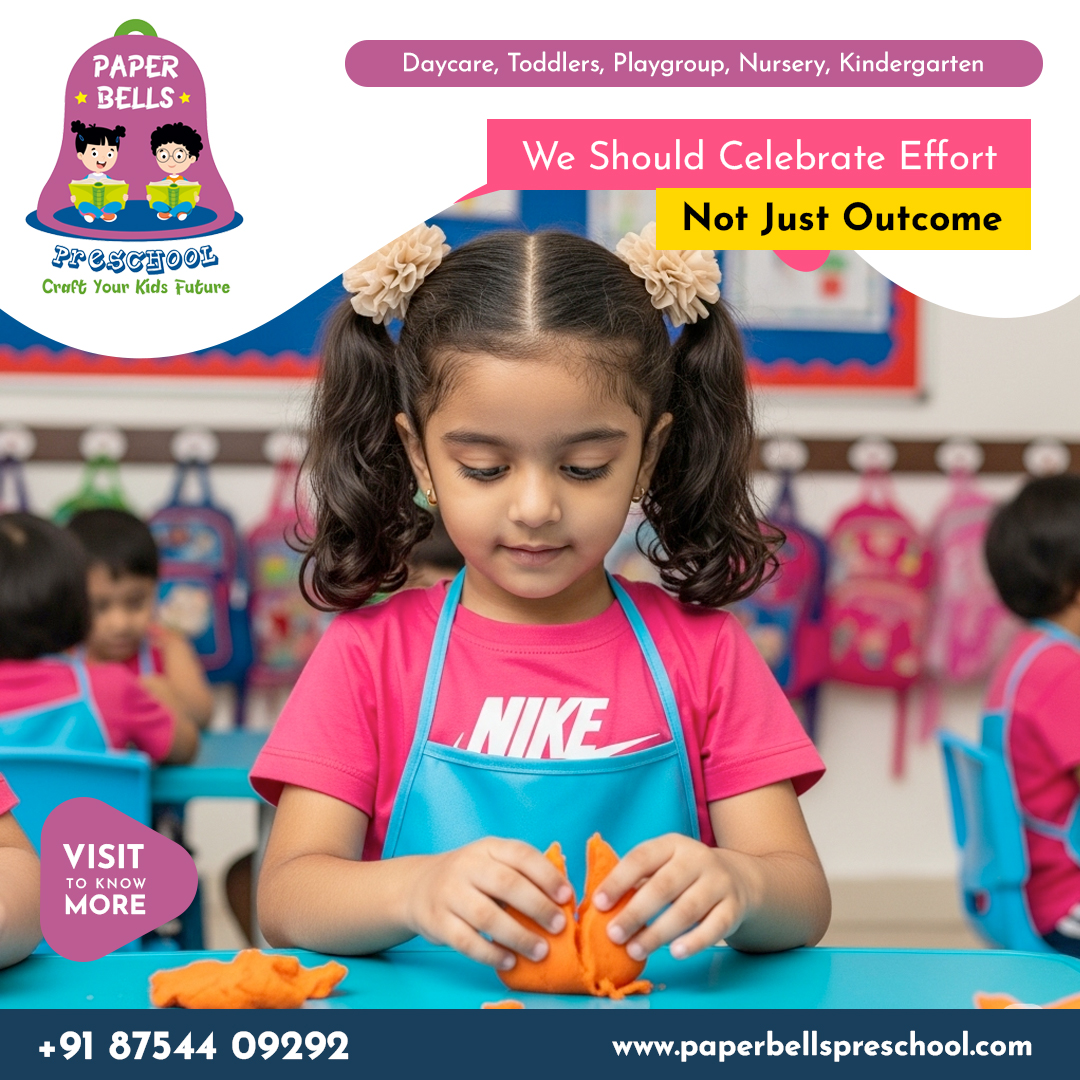
At Paperbells Preschool, we believe that the process matters just as much-if not more-than the result. A child’s scribbled drawing, a half-built block tower, a sentence spoken with hesitation - these may seem like unfinished moments to an adult eye. But to us, they are stories of courage, perseverance, and learning in motion.
In early childhood, growth doesn't come wrapped in neat results. It comes in the trying, in the repeated attempts, in the willingness to keep going even when something feels new or difficult. That is why, in our classrooms, effort is always noticed, always valued, and always encouraged.
Beyond the Gold Stars
It’s easy to praise the final product - a tidy worksheet, a memorised rhyme, or a perfectly painted shape. But at Paperbells, we pay just as much attention to how the child got there.
Did they try again after getting frustrated? Did they ask for help when needed? Did they persist when they weren’t sure how to begin? These are the small wins that reveal big things - resilience, patience, and confidence taking root.
When children know that their efforts are seen and appreciated, they begin to take greater initiative. They stop fearing mistakes. They start enjoying the challenge. They learn that learning is not about being the best - it’s about becoming their best.
The Role of Teachers in Nurturing Effort
Our educators at Paperbells are not just instructors - they are gentle encouragers, skilled observers, and champions of the child’s unique journey. When a child struggles to cut along a line or pronounces a new word for the first time, our teachers don’t just correct or clap; they reflect, acknowledge, and walk with the child.
They might say, "I saw how you kept trying even when the scissors felt tricky - that’s what learning looks like," or "You didn’t give up on the puzzle even when it got hard - that tells me you're becoming a great problem solver."
This kind of feedback fosters intrinsic motivation. Instead of performing for applause, children begin to trust their own process. They develop the most powerful habit of all - the habit of effort.
A Culture of Encouragement, Not Comparison
In many traditional settings, children are rewarded for speed, neatness, and accuracy - often unknowingly fostering competition over collaboration. At Paperbells Preschool, we take a different approach. We create an environment where children can celebrate each other's efforts, not compete against them.
If one child builds a tall tower and another builds a wobbly one but beams with pride, both are celebrated. If a child shares a story in front of the class for the first time, they are applauded - not for how well they spoke, but for the courage it took to try.
By removing the pressure of perfection, we open the door to joyful participation. Children feel safe to take risks, to be imperfect, and to grow at their own rhythm. And that kind of learning stays with them far beyond preschool.
Building Lifelong Learners, Not Just Early Achievers
When we teach children to value effort, we’re giving them more than encouragement - we’re equipping them with a mindset that will support them throughout life. They’ll approach new challenges with curiosity rather than fear. They’ll measure success not by where they end up, but by how much they’ve grown along the way.
This philosophy runs deep through our curriculum, routines, and classroom culture. Whether it’s a messy art session, a group discussion, or a quiet moment of trial and error, every experience is seen as a step forward.
Parents as Partners in the Journey
We gently guide families too, helping them shift focus from only outcomes to the bigger picture of growth. When parents celebrate the small wins - the trying, the asking, the steady improvement - children feel more confident and connected. It’s not uncommon to hear a parent say, "We’re learning to enjoy the process, not just the product," - and that, to us, is a celebration in itself.
A Preschool that Sees the Whole Child
At Paperbells Preschool, one among the best preschools in Hebbal, we believe that every child brings with them a story - a rhythm, a pace, a personality. Our role is not to rush them toward outcomes but to walk beside them as they explore, wonder, and try. Again. And again.
We celebrate the slow build, the thoughtful pause, the messy middle. Because this is where real growth happens. And because this is where children learn to believe in themselves - not just when they win, but when they try.
In our classrooms, effort is never invisible. It’s cherished, highlighted, and nurtured. After all, the habit of trying - wholeheartedly, joyfully - is one of the greatest gifts early education can offer.


