
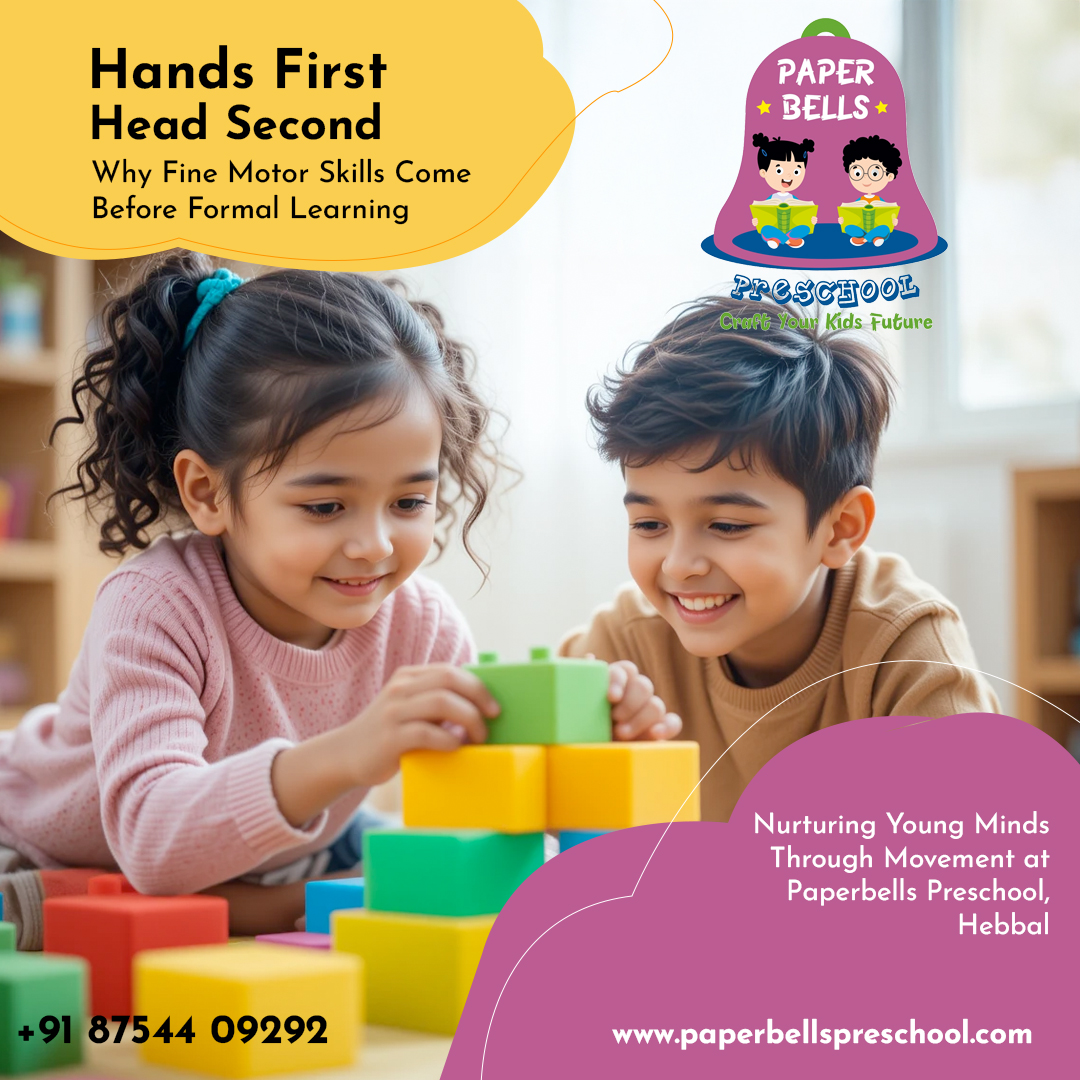
Nurturing Young Minds Through Movement at Paperbells Preschool, Hebbal
At Paperbells Preschool, Hebbal, we understand something that research-and experience-continue to affirm: before a child can write their name, solve a puzzle, or follow instructions in a classroom, they must first build the skills that begin in their fingertips. These early movements-pinching, pouring, threading, squeezing-may seem small, but they are the earliest steps toward big developmental leaps.
In today's world, where academic pressures can sometimes overshadow developmental readiness, we believe it's essential to slow down and focus on what truly matters: how children's hands shape their brains long before a worksheet ever does.
Why Fine Motor Skills Come First
Children are natural learners, but their learning doesn't begin with letters and numbers-it begins with motion. From the moment they reach out to grasp an object, they're starting a journey of coordination, problem-solving, and independence. Fine motor skills-those small, precise movements using the fingers and hands-form the foundation for future tasks like writing, cutting, drawing, and eventually, academic learning.
At Paperbells Preschool in Hebbal, we build our curriculum around this insight. We design daily experiences that engage the hands first, because we know that's where deeper learning begins.
The Power of Hands-On Learning
In every Paperbells classroom, you'll see a quiet revolution taking place-not through lectures or flashcards, but through child-led exploration. A child threading beads onto a string is refining their grip, hand-eye coordination, and concentration. A child pouring water from one container to another is experimenting with control, patience, and spatial understanding. A child pinching playdough is strengthening the muscles they'll one day use to hold a pencil with confidence.
These aren't isolated activities-they're part of a carefully planned, developmentally appropriate environment where movement is learning and play is purposeful.
How Movement Builds the Brain
Science tells us that movement and cognition are deeply connected. Every time a child engages in a hands-on activity, their brain is actively building connections that support logical thinking, memory, language, and emotional control.
For instance:
- Pouring and scooping builds early mathematical thinking-like understanding volume, balance, and sequence.
- Threading and pinching improve bilateral coordination and fine motor control, which are essential for writing.
- Molding and squeezing playdough or clay develops proprioception-how the body moves in space-and lays the groundwork for controlled, deliberate movement.
At Paperbells Preschool, we prioritize these types of activities not just because they're fun, but because they prepare children for the complex, abstract tasks that lie ahead.
Self-Regulation Starts in the Hands, Too
Beyond academics, fine motor work also nurtures emotional development. When children are deeply engaged in a focused, repetitive task, they are practicing patience, persistence, and problem-solving. These moments help build self-regulation-the ability to manage frustration, cope with challenges, and keep trying.
Our teachers in Hebbal gently guide children through these experiences, encouraging them to slow down, notice details, and take pride in their small accomplishments. Over time, children develop a quiet inner strength-the kind of confidence that grows not from instant success, but from steady effort.
Why It Matters at Paperbells Preschool, Hebbal
At our Hebbal campus, we are proud to be part of a preschool community that values development over deadlines. As a thoughtfully run preschool, we focus not on rushing children toward academic outcomes, but on helping them gain the tools they need to reach those outcomes in their own time.
This means:
- Ample opportunities for free play and sensory exploration
- Carefully curated fine motor zones in every classroom
- Teachers who understand when to step back and when to gently support
- A rhythm of the day that includes repetition, calm, and mindful movement
By putting hands first, we ensure that every child is not only ready for formal learning-but also excited and equipped to embrace it.
Laying the Right Foundations, One Small Handful at a Time
Every time a child at Paperbells Preschool, Hebbal scoops sand, zips a jacket, or fits puzzle pieces together, they're not just playing. They're practicing persistence. Building neural networks. Developing a sense of control over their world.
In these small, everyday actions, a greater truth emerges: before they can write, they must squeeze. Before they solve, they must sort. Before they think clearly, they must move freely.
At Paperbells Preschool, we honor the natural order of growth. Because we know that when we begin with the hands, the mind is never far behind.


