
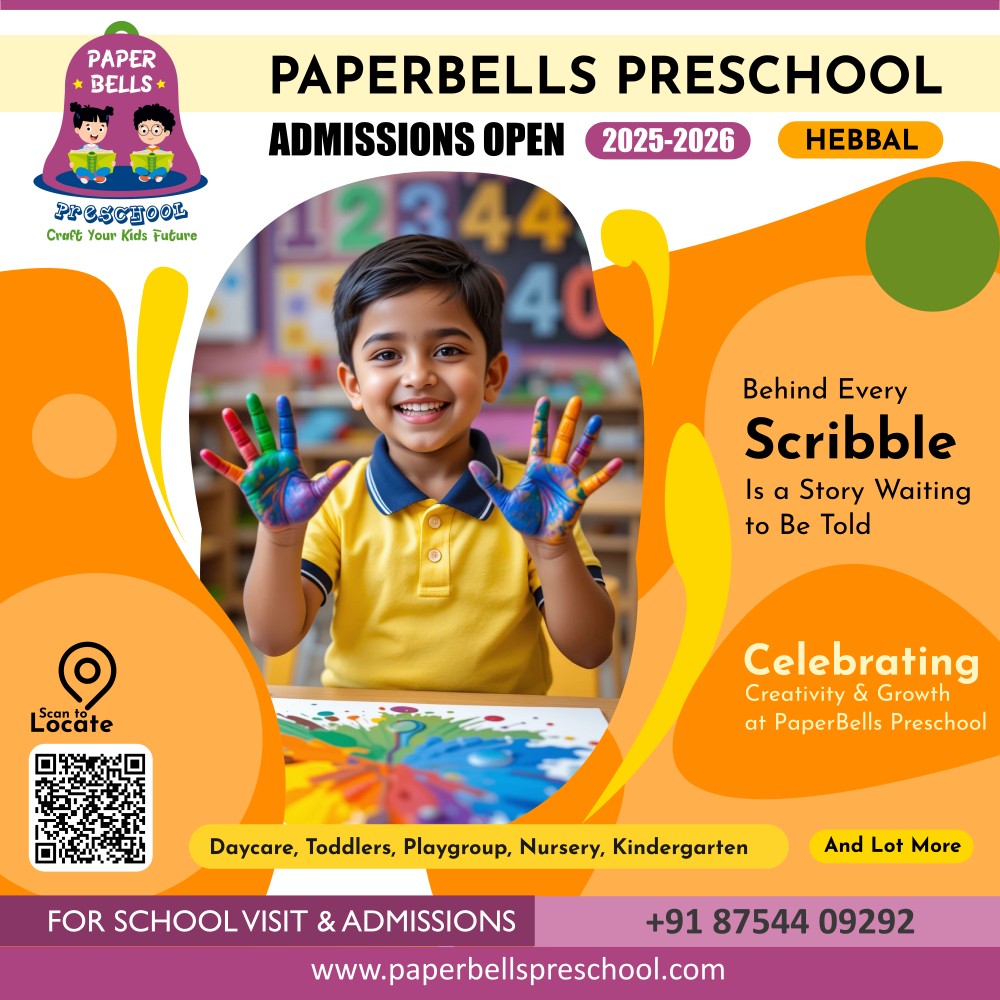
Celebrating Creativity and Growth at PaperBells Preschool
If you've ever received a drawing from a preschooler - swirls of color, random shapes, maybe even a few mysterious lines - you might have wondered, "What is this supposed to be?" But to a child, that scribble is so much more than just crayon on paper. It's a dragon flying over mountains, a memory of playing in the park, or a picture of their family (complete with purple hair). It's a story - one only they can tell.
At PaperBells Preschool, we believe these early marks are meaningful. Each scribble, line, and blot of paint is a step in a child's journey toward communication, confidence, and creativity. When we look beyond the messiness, we see magic: a young mind exploring, expressing, and growing.
The Power of Early Creativity
Children are naturally creative. From the moment they're able to hold a crayon or dip their fingers in paint, they begin using art as a language. Before they can write or even speak in full sentences, they're already telling stories with color and shape.
Creative play allows toddlers and preschoolers to explore their thoughts and emotions in a safe, open-ended way. Whether it's through drawing, painting, building, or imaginative role-play, they learn to express feelings they may not yet have words for. This is especially important in early childhood, when emotions are big and vocabulary is still developing.
But creativity is about more than just emotional expression. It encourages problem-solving, risk-taking, and divergent thinking - all of which lay the foundation for lifelong learning and adaptability. When children are encouraged to be creative, they're not just making art - they're making meaning.
Fine Motor Skills in Disguise
Every time a child grips a paintbrush, squeezes modeling clay, or draws with a pencil, they are strengthening the small muscles in their hands and fingers. These movements - while seemingly simple - are key to developing fine motor skills, which later support more advanced tasks like writing, cutting, buttoning a shirt, or tying shoelaces.
Early mark-making helps children practice hand-eye coordination, spatial awareness, and control. As they experiment with lines, dots, and shapes, they begin to build the muscle memory needed for drawing letters and numbers. What may look like a messy scrawl to an adult is, in fact, an important workout for a child's growing hands.
This is why access to a variety of creative tools - crayons, scissors, chalk, stamps, and even natural materials like leaves or sand - is so essential in the preschool environment. These tools give children the chance to explore textures and tools, all while building dexterity and control in ways that feel like play.
Creating Without the Pressure to "Do It Right"
One of the most valuable aspects of early art is that there is no right or wrong way to create. In a world where outcomes are often measured and compared, early art offers children a rare opportunity: to explore freely, without fear of failure.
At PaperBells Preschool, we celebrate the process over the product. What matters is not how neat the drawing is, but how absorbed the child is in the act of making it. Did they choose colors confidently? Were they focused on mixing paints or filling the page? Did they feel proud enough to show someone what they made?
These are the real achievements. And when a child's effort is met with encouragement and curiosity rather than correction, they are more likely to keep creating - and with it, continue growing.
Listening to What Can't Be Said
Behind every drawing is a glimpse into a child's inner world. A red sun might signal excitement. A house with ten windows might represent their extended family. Scribbles all over the page could be a sign of boundless energy - or even a way of managing big emotions.
Art becomes a bridge between what children feel and what they can say. It offers adults a window into their thinking, their worries, their dreams. When teachers and caregivers take the time to listen to a child explain their drawing - even if it's just "this is a rainbow and a rocket ship and a lion at the zoo" - they are sending a powerful message: your ideas matter.
This validation is a key part of building self-esteem and emotional intelligence. It tells children that their voice has value, even when it's expressed through scribbles and swirls.
A Space to Imagine and Invent
Creativity isn't confined to paper. It spills over into pretend play, block building, storytelling, and song. Every time a child builds a spaceship out of boxes, turns a stick into a magic wand, or narrates a dramatic tale with puppets, they are tapping into their limitless imagination.
In the preschool setting, nurturing this imagination means offering materials and time - but also freedom. Freedom to explore without being rushed. Freedom to create without needing a perfect result. Freedom to dream without boundaries.
These experiences don't just lead to better artists - they lead to better thinkers. Creative children are more likely to become adaptable adults, capable of viewing problems from different angles and imagining innovative solutions.
Every Scribble Has a Place
It's tempting to tidy away the finger paints or avoid messy craft time, but it's in these very moments that some of the richest learning happens. When we understand that scribbles are more than messes - when we recognize them as early attempts at storytelling, expression, and physical coordination - we begin to see creative play in a new light.
At PaperBells Preschool, we embrace the messy, the colorful, and the imaginative. Because we know that when a child proudly holds up a drawing and says, "This is my dragon in a castle," what they're really saying is: "I have something to share."
And that's a story worth hearing - every single time.


